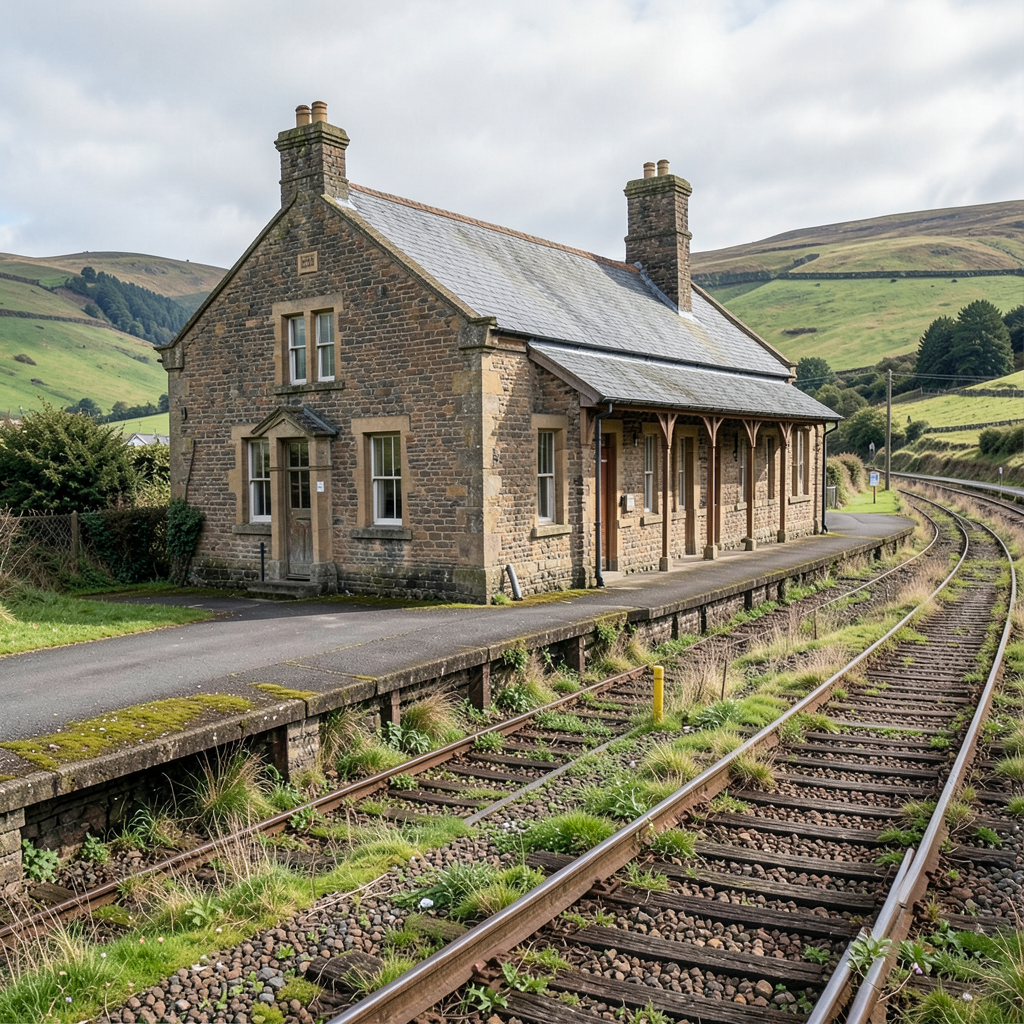

Senedd members are set to examine a formal request this week that could pave the way for restoring rail services to a historic South Wales valleys community.
The petition, which garnered support from more than four hundred residents, urges officials to explore the possibility of reopening the former Nelson and Llancaiach Station.
The matter will be reviewed during a dedicated session of the Senedd’s Petition Committee on Thursday afternoon.
The campaign calls for an initial investigation into establishing a rapid bus connection reaching existing railway hubs, before pursuing the longer-term goal of restoring the station itself.
The community lost its railway connection in 1964 as part of the widespread line closures implemented under the Beeching cuts, which fundamentally reshaped Britain’s rail network during that period.
The original facility was constructed primarily to support operations at the nearby Llancaiach Colliery and occupied a strategic position on two intersecting routes that handled both goods and passenger traffic throughout the valleys region.
Although the main station buildings were pulled down in 1972, a portion of the railway corridor remains active for freight operations along the Taff Bargoed branch line.
Passengers wishing to board trains currently must travel approximately two miles to reach Ystrad Mynach station.
The former Nelson and Llancaiach facility at Tawelfan first welcomed passengers on 1 July 1912, having been established by the Rhymney Railway as a replacement for the neighbouring Llancaiach station.
The structure was positioned on the northern side of the Tawelfan locality.
Despite the closure six decades ago, both the formation and station platforms continue to exist in situ.
Local community councillor Aled John, who lodged the petition, expressed satisfaction that the committee would consider the proposal.
The elected representative thanked all those who added their names to the campaign.
Regional member Lindsay Whittle acknowledged that more than sixty years had elapsed since rail services ceased operating through the village.
The Blaenau Gwent Caerffili Rhymni representative described the closures of that era as lacking foresight and insisted that the surviving infrastructure offered a practical foundation for restoration.
The former member argued that contemporary transport needs demanded alternative options beyond private vehicles for both commuting and recreational purposes, suggesting immediate steps were warranted.
Fellow representative Niamh Salkeld recognised the significance of the issue to constituents, having noted the volume of signatures gathered.
The member endorsed efforts to strengthen public transport connections across the valleys and identified the proposed development as requiring further engagement with Welsh Government officials.
The petition documentation sets out the case for examining the viability of reopening the station.
Campaigners point to the existence of the former line, which carried freight traffic until relatively recently, running between Ystrad Mynach and Merthyr Tydfil while traversing Nelson, Trelewis, and Bedlinog.
Proponents contend that linking Nelson to the broader rail network would represent a logical improvement while simultaneously reducing traffic on local highways.
Plaid Cymru representatives previously pressed the UK Government in 2025 to examine the prospects for reconnecting the Nelson area to the railway system.
Lindsay Whittle, serving as the Caerphilly representative in the Senedd, formally approached UK Rail Minister Lord Hendy of Richmond to request a feasibility assessment.
Railway infrastructure falls under reserved matters at Westminster, meaning any decisions regarding line reopenings require approval from the UK Government rather than Welsh authorities.
Deputy Minister for Social Care Delyth Jewell indicated at the time that pursuing the route would bring into focus persistent concerns about how rail investment is allocated to Wales.
The minister highlighted the classification of major schemes such as HS2 as England and Wales expenditure for budgetary purposes, despite those projects operating exclusively in England.
Unlike the devolved arrangements in Scotland and Northern Ireland, Wales does not benefit from a comparable Barnett formula adjustment for heavy rail spending.
Ms Jewell characterised the existing funding methodology as profoundly inequitable, arguing that Wales effectively subsidises English infrastructure projects while receiving no corresponding allocation for its own network requirements.
Peredur Owen Griffiths pointed out that funding decisions originating from Westminster bore little relationship to Welsh network requirements, population distribution, or the condition of existing infrastructure.
The member expressed concern that change had been limited despite the political shift at Westminster.
Welsh ministers possess powers to invest in services and manage the Wales and Borders rail franchise, yet no specific budgetary provision exists for rail infrastructure development.
The UK Government retains responsibility for network planning and enhancement, with the exception of the Core Valleys Lines, which transferred to Welsh ownership in 2020.
A comprehensive feasibility examination would be anticipated to assess the condition of existing track, identify engineering challenges, project potential passenger numbers, estimate costs, and evaluate environmental considerations.