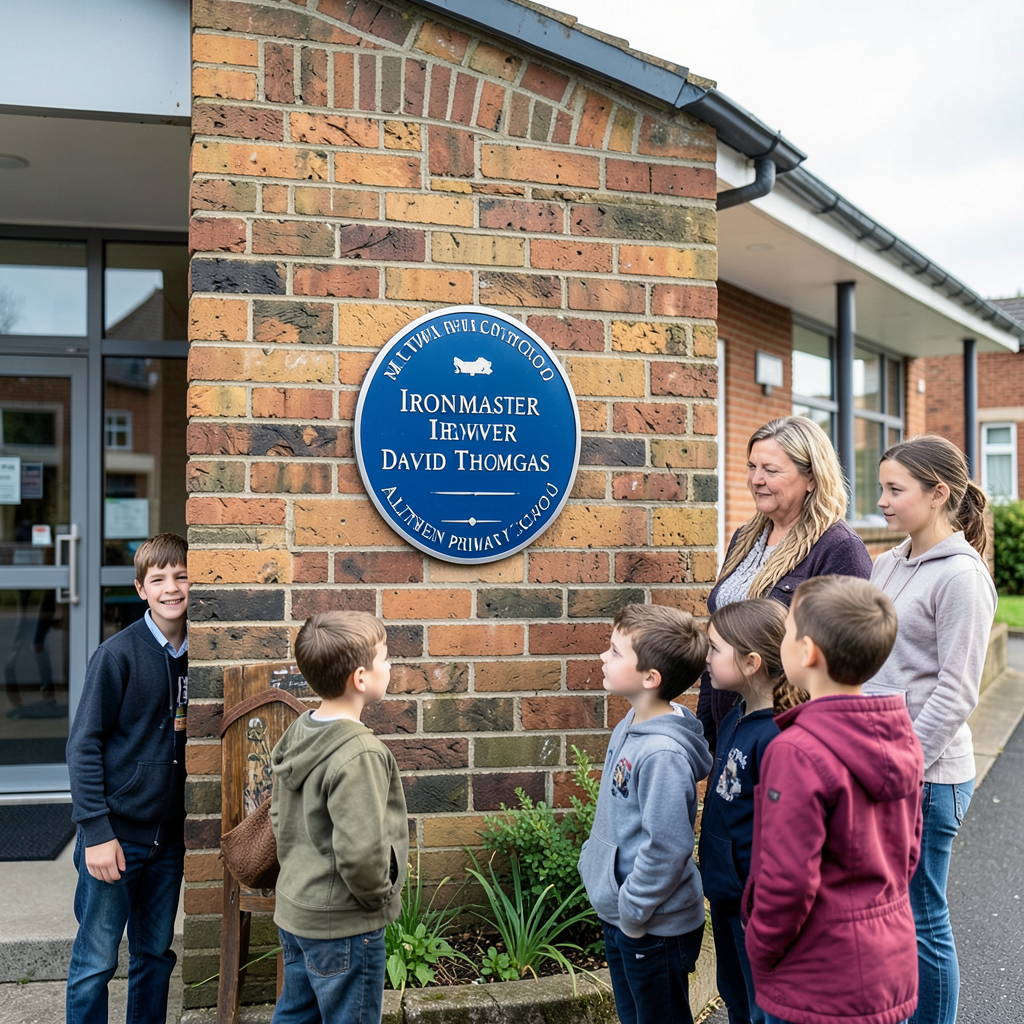

A commemorative blue plaque was unveiled at Alltwen Primary School to recognise the contributions of David Thomas, a Welsh ironmaster whose innovations left a lasting impact on industrial processes in both Wales and the United States.
Born in 1794 at Ty-Llwyd Farm in Wernddu, situated within what is now Neath Port Talbot, Thomas pursued his education locally before undertaking a five-year apprenticeship at Neath Abbey Iron Works, one of Wales’ most significant industrial establishments during that period.
Following his training, he secured employment at the Ynyscedwyn Ironworks in Ystradgynlais, where he devoted more than two decades to refining his craft as an ironmaster.
During this time, he established himself as one of the foremost figures within the British iron sector.
In 1837, Thomas accomplished what would become his most celebrated breakthrough by devising a technique for smelting iron ore through the use of anthracite coal combined with a heated blast furnace.
This process offered a straightforward approach to manufacturing anthracite iron and fundamentally transformed industrial operations throughout the Swansea Valley region.
Four years later, in 1839, Thomas relocated to Pennsylvania alongside his family.
The Lehigh County area proved ideally suited to his expertise, possessing abundant reserves of both anthracite coal and iron ore.
Within twelve months of his arrival, the inaugural successful anthracite iron furnace in America commenced operations.
This advancement streamlined iron production, rendering it more economical and effective while propelling the Industrial Revolution forward.
His pioneering methods facilitated substantial growth within the iron and steel sectors across both continents.
Thomas earned recognition as the Father of the American Iron Industry, a designation that subsequently inspired the affectionate moniker Papa, which appears on the commemorative plaque.
In 2023, he received posthumous induction into the Iron and Steel Hall of Fame.
Prior to the official ceremony at the school, students delivered presentations and performed musical pieces recounting the industrialist’s life story.
The initiative to install the plaque was put forward by Independent Councillor Bob Woolford, representing the Rhos ward.
During proceedings at the unveiling, Councillor Woolford explained that Thomas had shaped industrial development first in Wales and subsequently in America.
He observed that the children had articulated his narrative effectively and noted that commemoration was thoroughly deserved.
Councillor Cen Phillips, who holds the portfolio for Nature, Tourism and Wellbeing, stated that Thomas’s accomplishments underscored Neath Port Talbot’s historical significance as a hub of industrial ingenuity and engineering prowess.
He explained that the advancement of blast furnace technology had become integral to the steel sector, which had formed a core component of Port Talbot’s character throughout the twentieth century.
Councillor Nia Jenkins, responsible for Education and Early Years matters, described the occasion as an excellent learning opportunity for the young learners at Alltwen Primary School to discover about this influential industrialist connected to their own locality.
She expressed that the blue plaque served to acknowledge Neath Port Talbot’s contribution to the Industrial Revolution and might potentially motivate students to pursue future careers in science, technology, engineering and mathematics, following in Thomas’s footsteps.