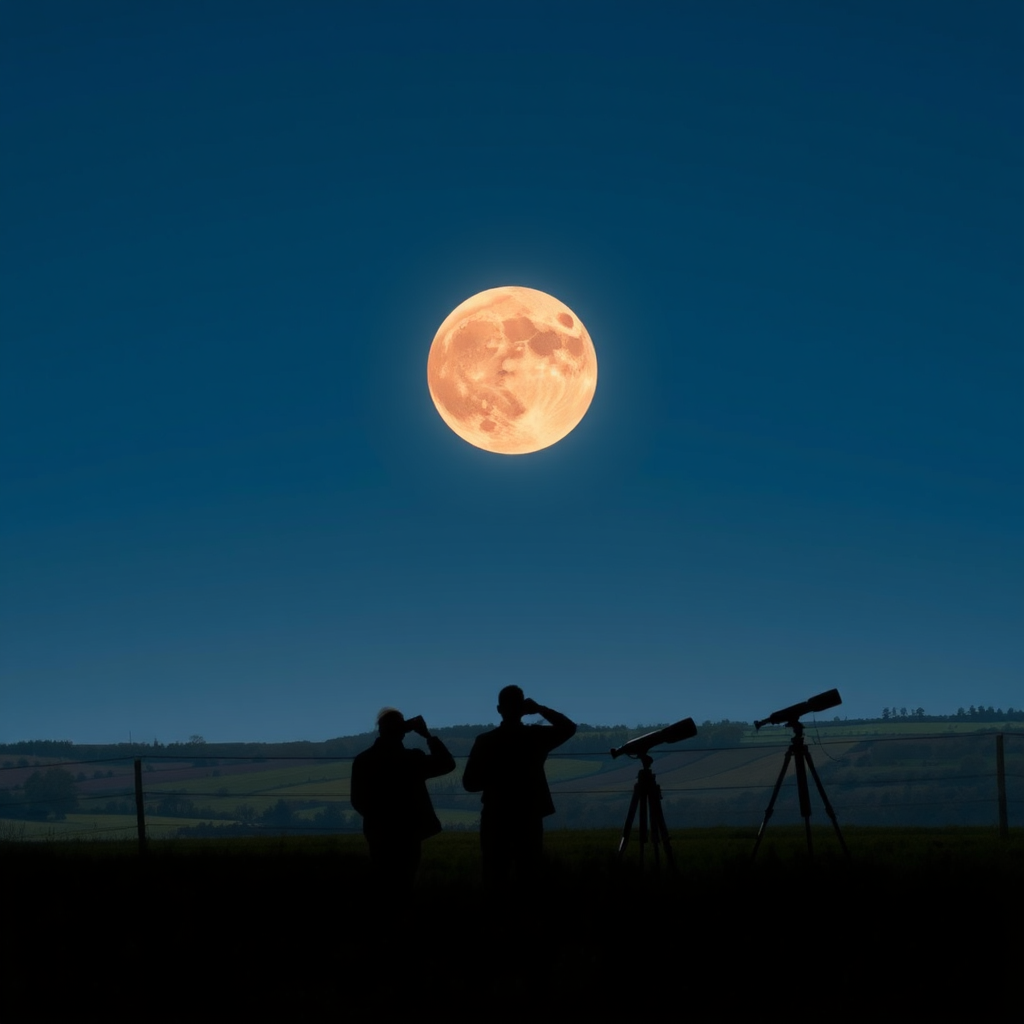

The April full moon, known as the Pink Moon, will soon grace British skies, with optimal viewing conditions attracting astronomical enthusiasts. Indigenous peoples of northern North America gave this lunar event its name, drawing inspiration from an early-spring wildflower species. Beyond its cultural significance, this particular full moon plays a crucial role in establishing the dates for major religious celebrations including Easter and Passover.
Despite its evocative name, observers should not anticipate a pinkish tinge when the moon becomes visible. Alternative designations for this celestial occurrence include the sprouting grass moon, the egg moon, and the fish moon.
On the evening of Wednesday, April 1st, the moon will emerge above the horizon at a relatively low angle, making an orange appearance far more probable than any pink coloration. This visual phenomenon occurs because the sunlight reflected from the lunar surface passes through a thicker section of Earth’s atmosphere, which filters out blue and violet wavelengths while permitting the redder spectrum to reach observers on the ground.
The moment of maximum brightness is scheduled for 3:12am during the early hours of Thursday, April 2nd. Current meteorological projections indicate that cloud cover and precipitation are expected across England and Wales on Wednesday evening, potentially obscuring the view. Those in Scotland and Northern Ireland stand a better chance of witnessing the spectacle, as clearer conditions are anticipated in the cooler air masses affecting those regions.
A typical year experiences approximately twelve full moons, with each occurring at intervals of roughly 29.5 days—the precise duration required for the moon to complete one orbital revolution around Earth and cycle through all its phases. Following the Pink Moon, stargazers can anticipate the Flower Moon, which will appear in May.
The Pink Moon’s significance extends beyond mere observation, as it helps determine the timing of Easter and Passover. Easter’s annual date depends entirely on astronomical calculations, specifically falling on the first Sunday immediately following the first full moon that appears after the spring equinox. The precise moment of the astronomical equinox naturally shifts between March 20th and 21st each year. In 2026, this occurs on March 20th. Historically, Christian authorities established a fixed reference point of March 21st to standardise their computations. Because the first full moon after March 21st materialises on April 2nd, Easter falls on the subsequent Sunday, April 5th. When a full moon coincides with a Sunday, Easter is postponed to the following week.