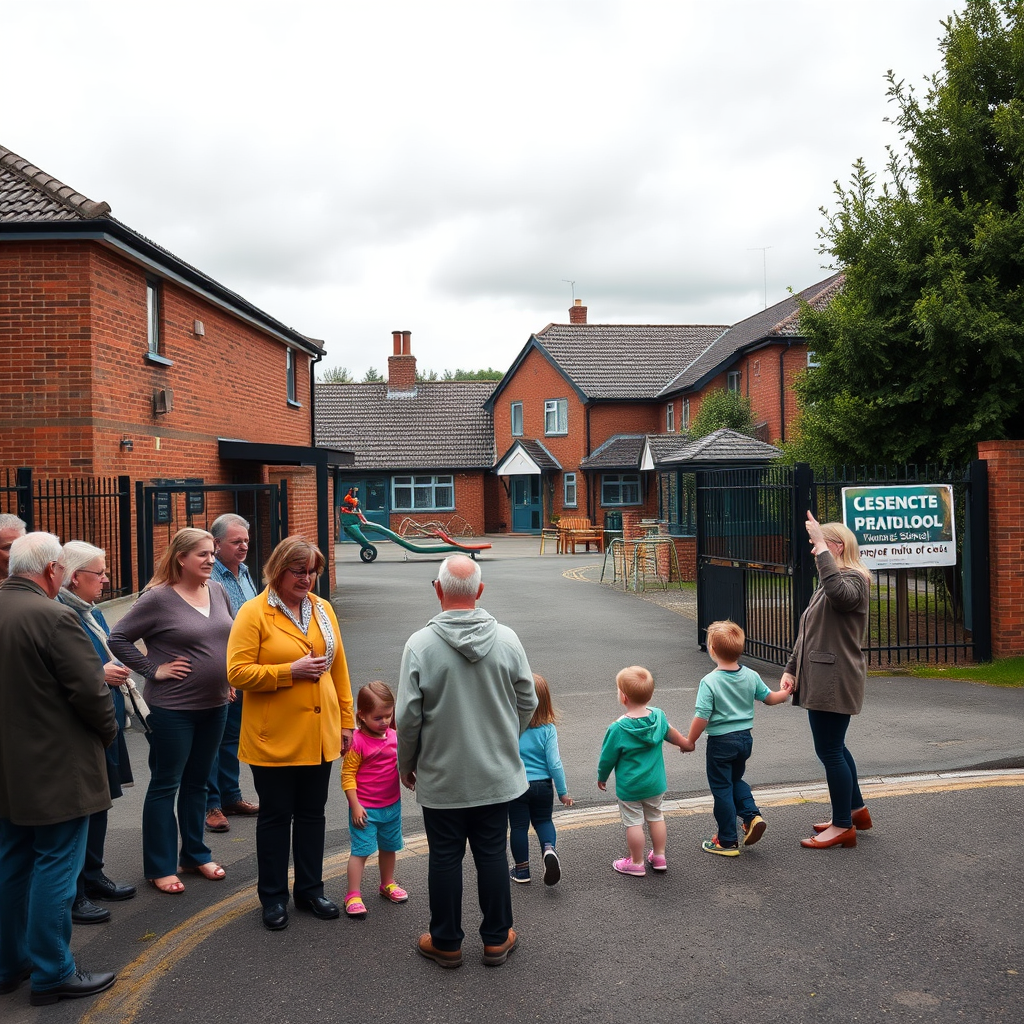

A plan to close a primary school in Abertillery has encountered fierce resistance from local people.
Almost all respondents to a questionnaire about closing the Roseheyworth primary campus of Abertillery Learning Community (ALC) dismissed the idea.
At an extraordinary meeting of Blaenau Gwent County Borough Council’s Labour Cabinet set for April 30, senior council figures will face a challenging choice with two options that will shape Roseheyworth school’s future.
They can either continue with the unpopular closure process or look at other ways to address the financial problem caused by spare capacity at ALC.
In February, Cabinet approved launching a public consultation on a proposal to close Roseheyworth at the end of August 2027, with the aim of reducing surplus places at ALC, which provides education for pupils aged 3 to 16.
This change would cut the all-through school’s pupil capacity from 980 to 770 pupils beginning September 2027.
The consultation, held from March 2 to April 14, attracted 797 replies, although 46 were discarded as duplicate submissions from the same people.
This left 751 valid questionnaire responses: 704 (94 per cent) rejected the plan, 33 (four per cent) fully supported it, and the remaining 14 (two per cent) offered partial backing.
A more detailed breakdown showed that 247 of 255 parents objected to the proposal, together with 271 of 284 local residents who gave their views.
Among school governors, four disagreed while three supported the plan.
The document stated that, as anticipated, the consultation revealed substantial resistance, especially from parents, local residents and staff working at the school.
The consultation provided the council with extensive qualitative and quantitative feedback from parents and carers, pupils, staff, governors and the wider community.
The council re-examined the proposal against the original rationale: declining pupil numbers, ongoing surplus capacity, financial sustainability difficulties, and preserving suitable educational standards.
This review incorporated input from the consultation, supporting paperwork and further analysis carried out during the consultation period.
As part of the consultation process, various alternative approaches were proposed beyond those previously examined.
These alternatives involved reducing the size or capacity of three primary-phase sites; running the three campuses as lower, middle and upper phases, including early years and post-16 education; and moving pupils across the campuses to achieve a more even distribution of enrollment.
The document notes that ALC, working with an £11.1 million budget this year, is currently facing a projected shortfall of £898,000.
The report indicated that without intervention, this deficit is projected to reach £1.7 million by March 31, 2027, and escalate substantially to approximately £4 million by 2029/30.
The proposal would help the school move toward achieving an annual balanced budget by generating yearly savings of roughly £670,000.
Over five years, these savings are anticipated to amount to approximately £2.2 million, substantially reducing the deficit.
The report further stated that if the proposal moves forward, ALC will face sustainability concerns, as surplus capacity of this magnitude renders the school financially unviable, pulling resources away from student support.
By closing one campus, the risk is considerably lowered and becomes more manageable for both the school and council.
Known as a super school, ALC was created in September 2016.
The institution came into being through merging Roseheyworth Road, Six Bells Road and Tillery Street primary schools, along with Abertillery Secondary School.