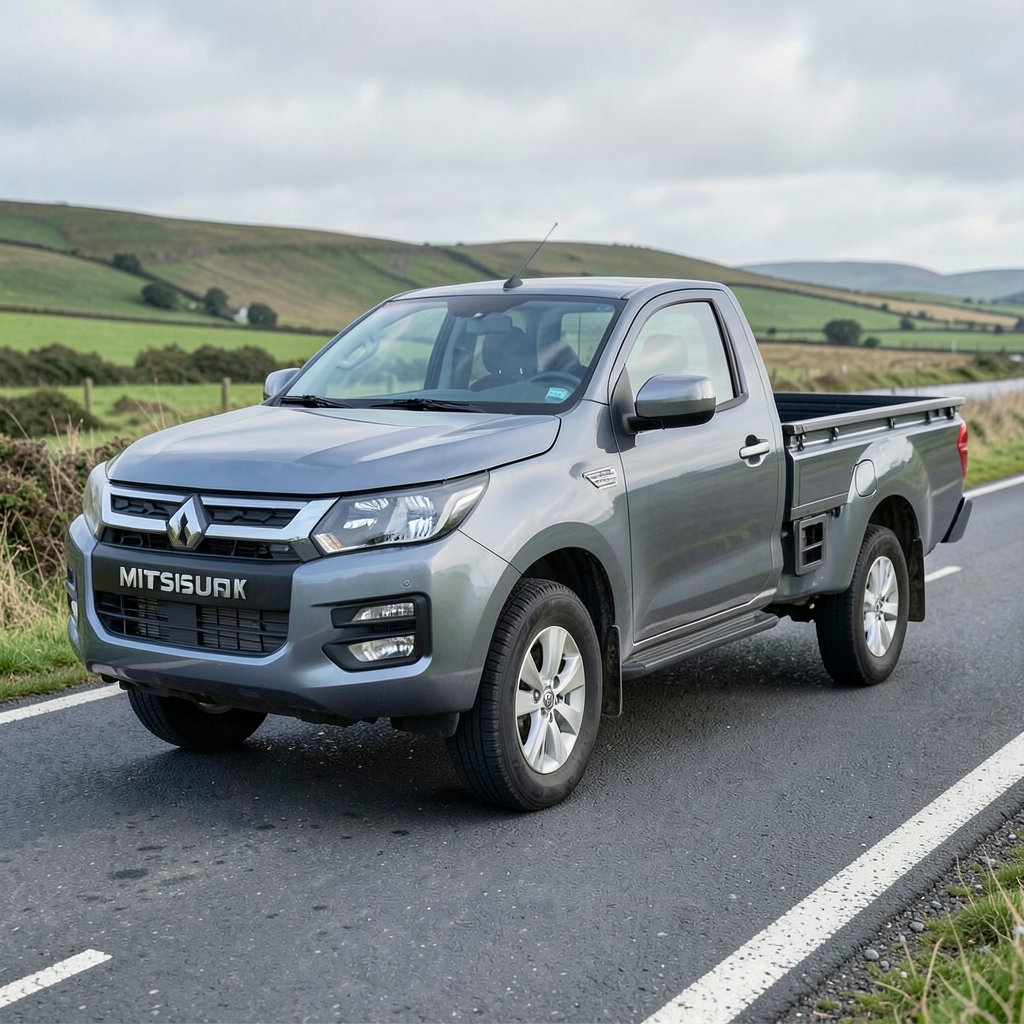

The Mitsubishi L200 pick-up has returned to British roads after a four-year absence, with the seventh generation of the workhorse arriving with a comprehensive overhaul.
The vehicle, which departed the market in 2021 following an uninterrupted 43-year production run, has been relaunched by the International Motors group with an entirely new platform and a revised powertrain.
The latest iteration debuts a 2.4-litre diesel engine, promising increased output, improved fuel efficiency, enhanced specification levels, greater refinement, and superior all-terrain capability compared to its predecessors.
The lineup has been streamlined to five-seat double cab configurations available in Titan or premium Barbarian specifications, alongside a purpose-built Commercial derivative.
The flagship Barbarian variant receives the updated Super Select 4WD-II system, enabling drivers to engage full-time all-wheel drive across any surface via shift-on-the-fly functionality.
Seven terrain-specific drive modes cater to diverse conditions, while the payload capacity exceeds one tonne and the towing limit reaches 3.5 tonnes in this specification.
Pricing commences at £36,295 for the Titan and £39,995 for the Barbarian, before applicable taxes, with Commercial models commanding approximately £1,200 additional investment per variant.
International Motors assumed responsibility for the brand following Mitsubishi’s withdrawal from the British market in 2021.
Crucially, the company preserved an extensive parts distribution network and maintained nationwide aftersales operations, avoiding the necessity of establishing dealer infrastructure from the ground level.
Over 100 service centres operate across the country, with approximately 60 new vehicle showrooms developing around these facilities to support the L200 and recently introduced Outlander SUV, both bearing the manufacturer’s distinctive three-diamonds emblem.
The chassis employs coil springs at the front axle and conventional leaf springs at the rear, a configuration suited to carrying substantial loads and facilitating trailer towing.
During initial evaluation, the newly developed engine and seven-speed automatic gearbox demonstrated impressive pulling capability and smooth delivery.
The vehicle’s considerable mass prevents rapid acceleration, though engine refinement remains acceptable except under hard acceleration.
Ride quality proved composed and the chassis exhibited good stability.
In an earlier off-road introduction during the summer months, the L200 performed admirably on standard tyres, with the advanced traction control systems enabling confident hill starts and controlled descents.
Drive-mode selection operates through a rotary controller positioned behind the gear lever, complemented by dedicated buttons for hill descent control and selectable power or economy modes.
Stalk-mounted secondary controls manage exterior lighting and windscreen wipers, while spokes on the steering wheel host additional switches for overriding the central display.
The nine-inch infotainment touchscreen delivers sharp imagery and responsive operation, though the integrated navigation software appears outdated and cumbersome to operate.
Physical buttons below the screen govern climate control settings for temperature, fan speed, and airflow distribution, all of which performed effectively within the generously proportioned cabin.
Electric windows feature throughout the vehicle and substantial door mirrors can be adjusted from the driver’s armrest.
Storage solutions are abundant, with the centre rear seat cushion folding to reveal twin cup holders for rear passengers.
Mitsubishi has integrated side steps within the door sills to facilitate entry and exit.
Interior proportions are generous, aided by electrically adjustable and heated front seats featuring substantial cushioning and adequate lateral support.
Large windscreen wipers clear the glass efficiently following high-pressure washing, though no comparable system serves the rear windscreen, which proved unnecessary during testing.
Headlamp illumination provides extensive reach and width, with an automatic dipping function available.
This feature responded sluggishly when transitioning from artificial lighting to unlit sections but proved more prompt when moving from darkness into illuminated areas or encountering oncoming traffic.
At higher engine speeds, powertrain noise became apparent, while road surface noise persisted consistently and occasional wind noise originated from the driver door seal or mirror housing.
The tailgate releases via a central handle and lowers to approximately chest height, exposing a lengthy and wide load bed fitted with lashing points.
The platform accommodates a standard European pallet once access has been gained to secure the load.
The substantial overall dimensions exceed typical parking space constraints, and the low-geared steering demands considerable driver input in confined areas, though multiple camera systems provide valuable assistance.
On winding rural routes, the elevated driving position and expansive glass area facilitated relaxed progress at steady speeds, while motorway cruising presented no difficulties.
Fuel consumption aligned with reasonable expectations for a vehicle of this type in the current economic climate.
The five-year interval since the previous generation has yielded meaningful improvements in equipment levels and overall capability.
The familiar nameplate has returned in considerably improved form.