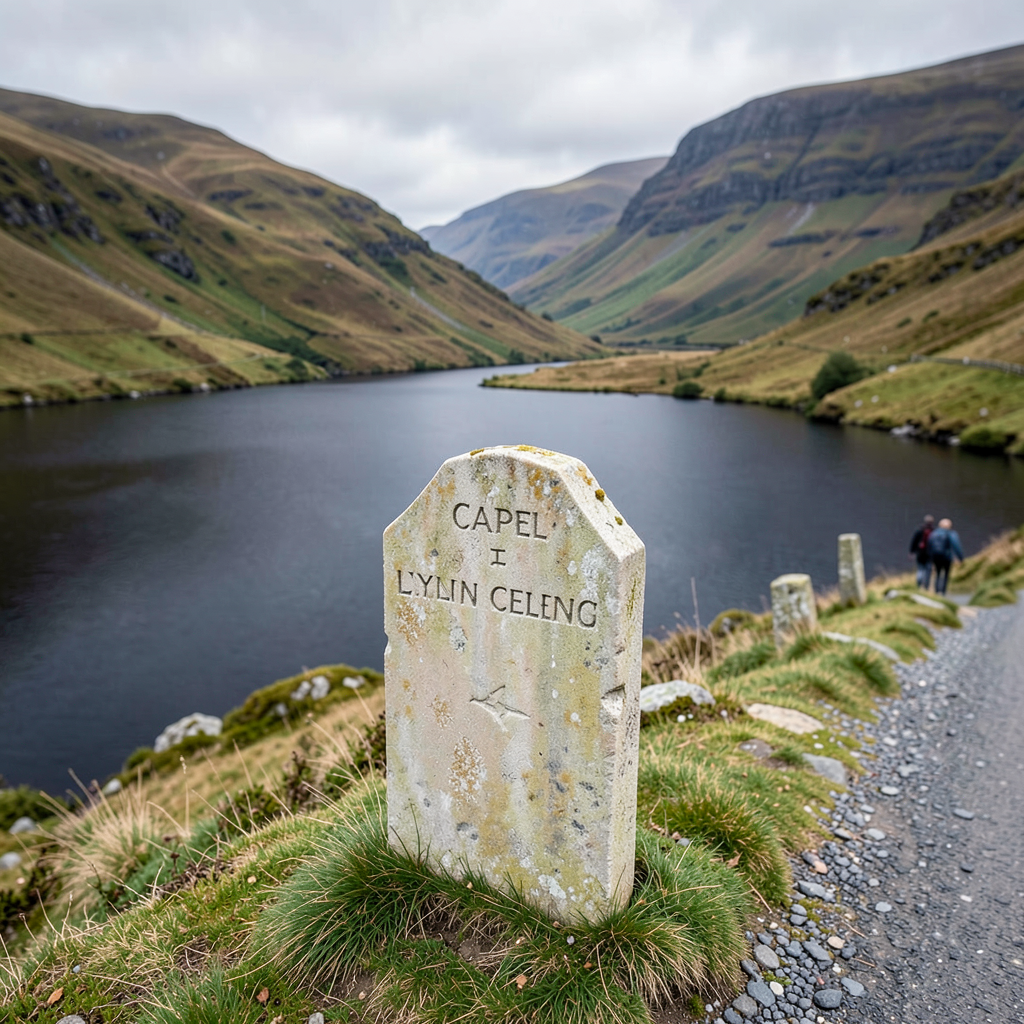

The memorial stone bearing the inscription Cofiwch Dryweryn has been restored at its roadside location in Wales.
On 21 October 1965, the community of Capel Celyn was submerged beneath the waters of Llyn Celyn, a reservoir constructed to satisfy Liverpool and Wirral’s water requirements.
The demolition of the settlement provoked opposition from 125 local councils, while every Welsh MP except those who voted against the legislation rejected the proposal when it reached its second parliamentary reading.
Wales at that period possessed neither a dedicated Welsh government department nor any meaningful self-governance, yet the consequences of the community’s destruction fundamentally shaped the future trajectory of the nation’s language and political development.
The residents of Capel Celyn learned of the development plans only days before the Christmas period of 1955, encountering the announcement within the Welsh-language version of a Liverpool newspaper.
A dedicated defence committee was established by the community, which subsequently campaigned against the scheme throughout Wales via newspapers, radio broadcasts and television appearances.
Two separate marches to Liverpool were organised by the villagers during 1956 to demonstrate their opposition directly to the city’s representatives.
Nonetheless, Liverpool city councillors confirmed their intention to proceed with the project by an overwhelming majority.
A private legislative measure sponsored by Liverpool city council was introduced in Parliament during 1957 to authorise construction of the reservoir within the Tryweryn Valley.
The proposed legislation would enable the flooding of Capel Celyn to proceed.
By securing approval through an Act of Parliament rather than standard planning procedures, the council would circumvent the need for consent from Welsh local planning authorities and would simultaneously avoid a public inquiry conducted under Welsh jurisdiction where objections might be formally registered.
The fact that Capel Celyn represented one of the remaining exclusively Welsh-speaking communities in the region ensured that the proposals attracted sustained and passionate opposition.
Four decades after the community disappeared beneath the water, Liverpool city council offered a formal acknowledgment of the injustice inflicted upon Capel Celyn’s residents and their descendants.
The apology was issued on 19 October 2005.
The response in the nearby town of Bala proved divided: certain residents received the council’s statement with cautious approval, while others characterized the gesture as politically hollow and excessively delayed.
The mural commemorating the flooded village has become one of Wales’ most recognised cultural symbols.
The artwork was created by the writer and academic Meic Stephens, whose son is the broadcaster Huw Stephens.
Despite his extensive contributions to Welsh literary culture, Stephens himself observed that no other creation he produced achieved the widespread cultural impact of this painted memorial.
The composition features white lettering against a vivid crimson field, the colour of the Welsh dragon and national flag, representing an assertion of defiance and collective resolve.
The image has been widely reproduced and has become synonymous with Welsh linguistic pride, resistance to cultural erosion and commitment to language preservation.
The anniversary of the flooding marked a turning point in Welsh political consciousness.
The stark realization of powerlessness experienced in 1965 galvanised a movement for linguistic and political empowerment.
Welsh speakers in particular intensified their campaigns for language rights, achieving significant milestones in subsequent decades.
The introduction of Welsh-language television services, expansion of Welsh-medium educational provision and the establishment of a Welsh parliament all represented tangible outcomes of this renewed determination to protect the nation’s distinctive character and heritage.
The story of Tryweryn has continued to inspire creative works across multiple artistic disciplines.
Musicians have drawn upon the theme in compositions addressing cultural loss and resistance, while poets have incorporated the reservoir’s existence into meditations upon Welsh identity and historical grievance.
An animated film depicting the Capel Celyn story premiered at a major Welsh film festival in October 2021, selected for inclusion in the festival’s celebration of Welsh cinematic achievement.
The filmmaker responsible for the project hails from a community on Anglesey and had previously pursued studies at a Bangor college before undertaking undergraduate animation studies at a Manchester university.
The creator viewed the festival platform as a valuable opportunity to disseminate the historical narrative to audiences beyond those already familiar with the story.
Work on the production intensified during the coronavirus pandemic, a period during which extended time at home enabled concentrated creative effort.
The filmmaker undertook animation and production responsibilities independently, subsequently collaborating with a musician for the soundtrack.
Upon sharing the completed work with fellow students at the university, a striking revelation emerged: awareness of the historical events proved considerably more limited than anticipated.
While the memorial wall itself had achieved recognition, the underlying narrative of displacement and cultural erasure remained largely unknown among English audiences, particularly when the concept was presented to university peers.
The Tryweryn events have exerted a lasting influence upon Welsh artistic expression, inspiring songs, poems and now films that engage with the themes of loss, defiance and cultural memory.
The drowning of Capel Celyn symbolised more than the destruction of a single community; it came to embody the broader challenges confronting Welsh language and national identity.
The flooding demonstrated the extent to which Wales remained subject to decisions made without reference to the wishes or interests of its own population.
The disappearance of Capel Celyn entailed the displacement of seventy-five households, the loss of twelve working farms, a primary school, a place of worship and a post office.
These structures and the community they supported were permanently submerged.
The village represented one of the final strongholds of Welsh-only speech, and its obliteration under governmental authority underscored the vulnerability of smaller nations within the United Kingdom’s constitutional arrangements.
Subsequent political developments have marginally altered Wales’ constitutional position.
The nation now possesses directly elected representatives in Westminster and a dedicated legislative chamber, yet advocates maintain that further powers and recognition remain necessary to ensure Welsh communities receive appropriate consideration and respect in matters affecting their own territories and futures.