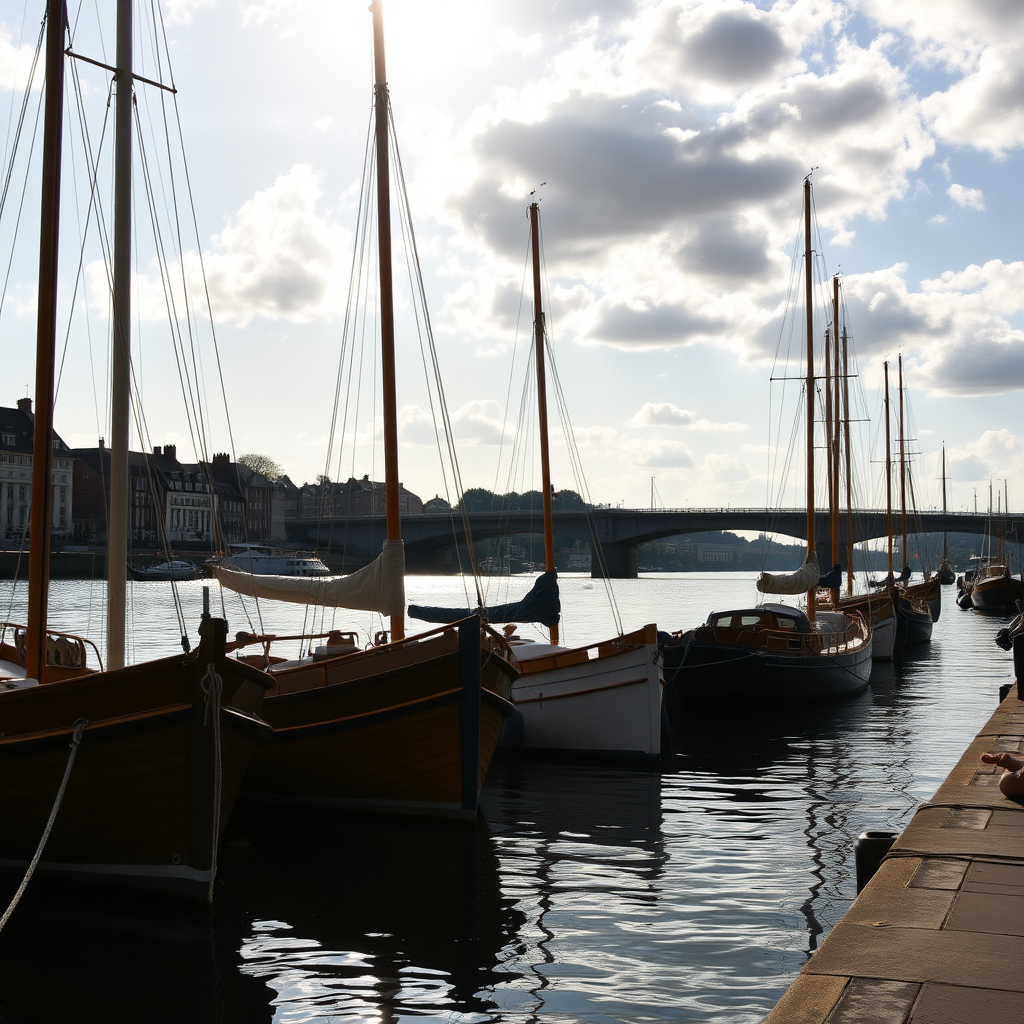

Twenty years before the present day, on 4 May 2006, the South Wales Argus ran an article urging that Newport’s association with pilot cutter vessels receive proper acknowledgment. The newspaper’s archives contain photographs of these vessels. Richard Frame, pictured in 2004, campaigned for a memorial to be established. The piece emphasised how crucial these boats had been in forming Newport’s maritime heritage, observing that no sculpture portrays the billowing sails and sleek hulls of the Bristol Channel pilot cutters, and their tale appears in only a handful of documents. These pilot cutters, which had been essential to Newport’s prosperity, have left almost no trace except for their hulls lying in the treacherous waters of the Channel. Yet demands for recognition of their contribution began surfacing more than eighty years after the final working pilot cutter passed out of sight. Mike Collins, from Rogerstone, photographed in 2006 after constructing a 1:14 scale model of the pilot cutter Spray, which had been registered at Newport in 1900. Richard Frame, at that time director of the Solas charity for homeless individuals and former chair of the now-defunct Newport Maritime Trust, remarked that a symbolic gesture of some description should surely be possible, noting that the pilot cutters had been equally as significant as the canals and tramways in unlocking the city’s industrial potential.
The article described how, prior to the outbreak of the First World War in 1914, pilot cutters hurried to meet incoming vessels from locations as distant as the Irish coast, with pilots remaining aboard while their apprentices navigated the ships back to port. Mike Collins, from Rogerstone, sails his scale model of the pilot cutter Spray at Tredegar House boating lake with his granddaughters Bethan and Tia in 2006. The Bristol Channel Pilotage Act of 1861 permitted Newport to have its own pilots, at the same time as commerce was expanding. However, by the conclusion of the Great War in 1918, the era of the Bristol Channel pilot cutter had come to an end, rendered obsolete by steam and diesel power. In 2006, only one pilot cutter, the Cardiff-based Mascotte, constructed in 1904, still navigated the Bristol Channel for recreational purposes. Two Bristol Channel pilot cutters were moored at Gloucester in 2015. Mike Collins, of Cwm Lane, High Cross, expressed frustration regarding the absence of commemoration for the pilots and their vessels, stating that nothing on the Newport waterfront serves to remind anyone of the hardships and dangers encountered by the sailing pilots of former times. Lindy Davis exhibited her end-of-year project, created from the remains of a possible Bristol pilot cutter recovered from the Usk riverbanks, at the Newport Ship venue in 2008. At the time of writing in 2006, Old Town Dock was undergoing excavation, giving rise to speculation about the possibility of a statue honouring the pilot cutters. The article also mentioned the Cariad, a pilot cutter discovered in 1988, which generated hopes for Newport to possess its own vessel. Mr Frame, who headed the maritime trust at that time, reflected that he still believed the Cariad could have been viable had she, as had been suggested at the time, been restored for educational and promotional purposes. Efforts were made to retain her but the project proved too daunting. The saddest day in the trust’s history occurred when she was taken back down the M5.