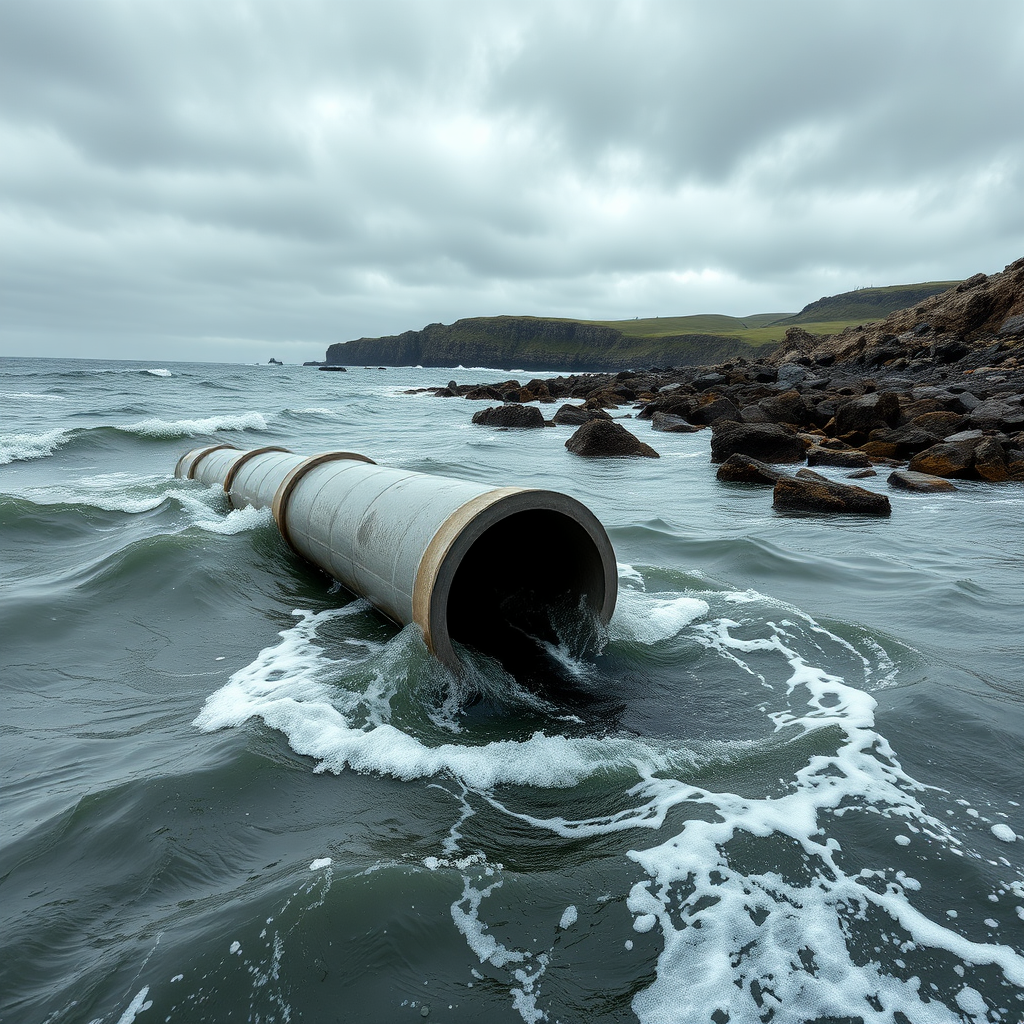

Reports indicate that drainage overflows persisted for extensive periods throughout the year despite 2025 being characterised by below-average rainfall.
Within the Welsh Water service territory during 2025, such overflows functioned for more than 790,000 hours, reigniting concerns regarding contamination, regulatory adherence, and the resilience of sewage infrastructure.
The data, examined by environmental organisation Afonydd Cymru, indicates a reduction of 14 per cent relative to 2024 figures.
Welsh Water represented over 30 per cent of the total discharge hours documented throughout England and Wales.
South West Water documented the highest volume in England, reaching 407,006 hours.
Storm overflow mechanisms are engineered to activate solely during periods of rainfall described as exceptional, with Welsh guidance specifying this as rainfall exceeding 4mm per hour.
Afonydd Cymru has questioned whether the scale of discharges documented could be attributable to precipitation patterns in 2025, a year broadly regarded as dry.
The organisation’s assessment drew upon freely accessible information from 149 Natural Resources Wales rain gauges, with 86 per cent positioned within 10km of a Welsh Water facility.
A representative for Afonydd Cymru stated that during a year with minimal rainfall, elevated overflow activity would typically be anticipated only in regions experiencing significant precipitation.
The representative noted that in certain districts, including the South East Valleys, the North East of Wales and along the boundary region, the primary sewage overflows functioned as anticipated, predominantly during periods of heavier rainfall as legally permitted.
Conversely, the environmental body identified instances of non-compliance in other locations.
The representative observed that examination of parts of West Wales reveals a contrasting scenario. Within these areas, numerous installations operated beyond their permitted parameters, with certain sites functioning for in excess of 5,000 hours throughout the year.
Afonydd Cymru additionally highlighted a modification in the distribution of discharges compared to years with greater precipitation, with wastewater treatment facilities accounting for a larger proportion relative to the broader sewer network.
This pattern, according to the organisation, underscores the necessity for immediate scrutiny and infrastructure upkeep.
Discharges occurring during dry spells pose particular challenges for river ecosystems, as reduced water flows diminish the dilution of sewage. This amplifies concentrations of detrimental contaminants and nutrients capable of harming natural environments.
The information has been provided to Welsh Water.
A company representative affirmed that the organisation is dedicated to enhancing its environmental credentials and will allocate over £4 billion to infrastructure between 2025 and 2030, encompassing £2.5 billion directed toward environmental improvements and £1.1 billion toward storm overflow upgrades.
The representative explained that within Wales, aligned with Welsh Government directives, priority is given to addressing storm overflows responsible for environmental damage first, rather than concentrating exclusively on discharge frequency. This strategy enables more comprehensive and rapid advancement in enhancing the quality of rivers and coastal waters.
The organisation is engaging with Afonydd Cymru to gain deeper insight into the datasets utilised and to identify opportunities for more precisely directing resources to enhance environmental outcomes.
Afonydd Cymru characterised the 2025 data as presenting a markedly different perspective on infrastructure deterioration compared to earlier periods.
The group advocated for improved comprehension of the underlying reasons for overflow malfunctions to ensure that funding is channelled toward interventions offering maximum benefit.
The organisation also emphasised the significance of guaranteeing that storm overflows are deployed solely when genuinely required and not permitted to become an habitual practice.
Afonydd Cymru stressed that this is crucial for safeguarding rivers, wildlife, and the wellbeing of communities throughout Wales.