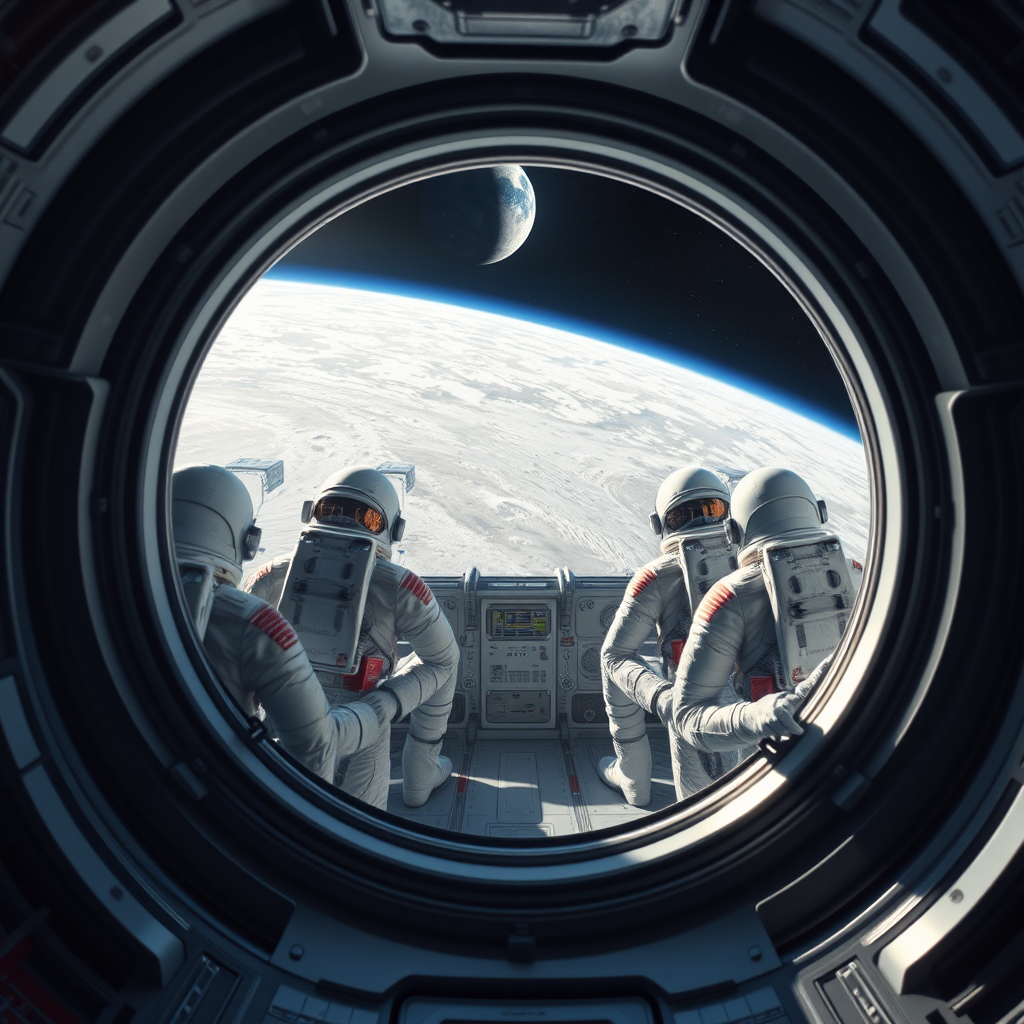

This week brought April’s full Moon illuminating the night sky, providing perfect conditions for humanity’s renewed push toward its closest cosmic neighbour as four astronauts embarked on a journey marking the first crewed lunar mission since Apollo 17 departed on 19 December 1972.
Reaching velocities of 24,500 miles per hour, the Artemis 2 expedition aims not merely to visit the Moon but to secure a place in history during its 10-day voyage. NASA’s strategy involves leveraging lunar gravity to perform a gravitational assist maneuver, slinging the Orion spacecraft and its crewmembers back toward Earth.
Although this particular mission will not touch down on the lunar surface, it will carry human beings farther into space than at any previous point, establishing foundations for subsequent expeditions intended to eventually land astronauts at the Moon’s southern polar region.
The financial aspects of such undertakings will likely provoke criticism from those who view them as unnecessary given current worldwide economic conditions. With individual launches costing $4 billion and the complete Artemis initiative estimated at approximately $93 billion, justification becomes necessary. What motivates NASA to pursue such ambitious lunar return objectives?
Echoing the unfulfilled 1960s rivalry between America and the Soviet Union to claim the honour of first human Moon visitation, the contemporary race now pits America against China. Beijing has announced plans to establish a crewed presence on the Moon by 2030, while NASA has targeted a 2028 lunar touchdown in an attempt to outpace the Chinese.
Proceeding steadily with their own orbital station comparable to the International Space Station, the China National Space Administration intends to construct a permanent outpost at the lunar South Pole by 2035. One cannot help but consider what might be accomplished through international cooperation instead.
This Saturday marks Comet C/2026 A1 (MAPS) reaching its nearest point to our star. The icy wanderer will streak past a mere 101,000 miles from the solar surface at velocities of 322 miles per hour, arriving at approximately 2:30 in the afternoon. During this maneuver, the comet must navigate an extremely sharp curved trajectory that threatens to demolish it entirely.
Should this celestial visitor emerge from its solar passage intact, observers can anticipate catching sight of it low along the western horizon following sunset. With potential visibility extending until mid-April, the comet may prove sufficiently luminous for naked-eye observation without requiring specialised equipment.
Additionally, two prominent planets will grace the evening heavens after dark. Venus commands attention as the Evening Star in the west-northwest direction, while Jupiter sits positioned toward the southwest, appearing somewhat dimmer than its planetary counterpart.
Astrophotography submissions welcome at: thenightsky@themoon.co.uk