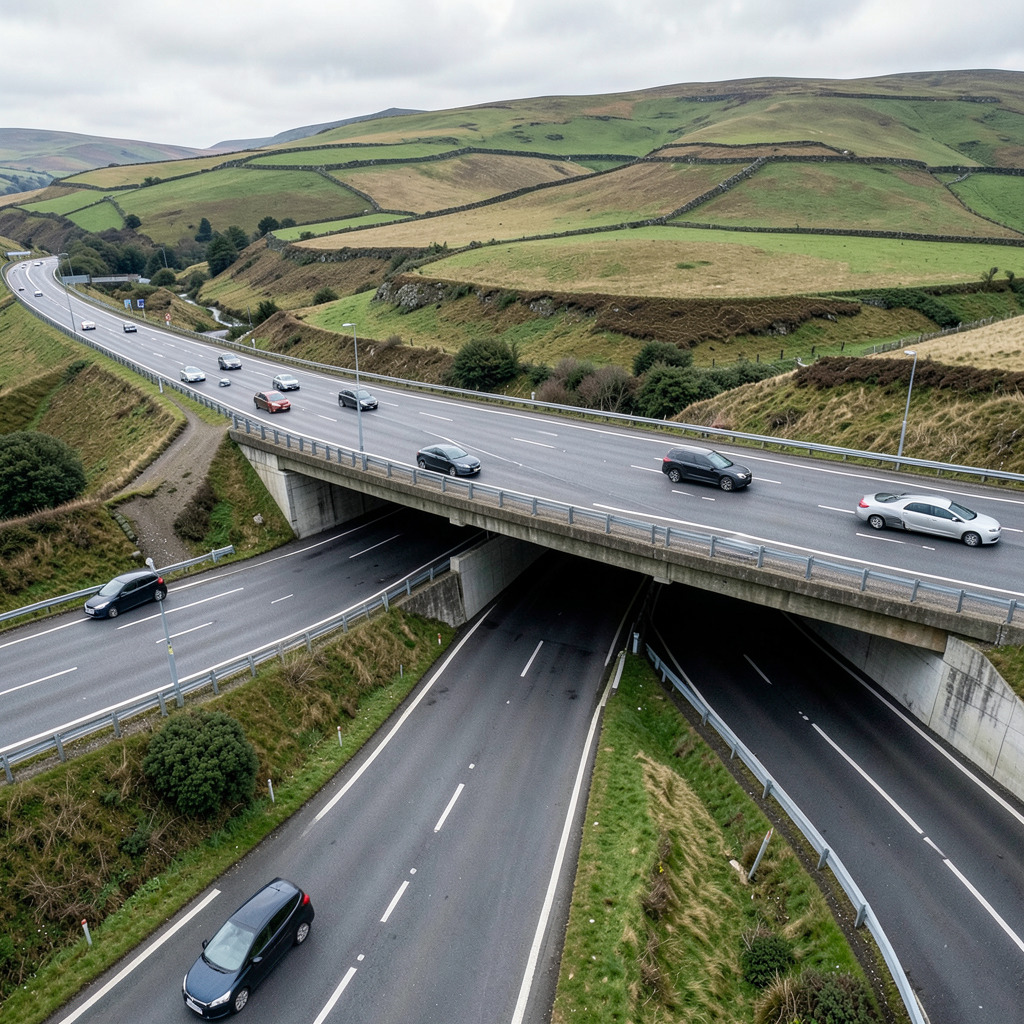

The Welsh Government’s recent transport announcement has raised significant questions about its strategic priorities.
While the Transport Minister unveiled plans for a third crossing of the Menai Strait connecting Ynys Môn to mainland Wales, the statement regarding the country’s most critical transport chokepoint near Newport offered little in the way of concrete solutions or definitive commitments.
The proposal for additional capacity across the Menai Strait has oscillated on the political agenda for several years, with the scheme’s trajectory closely tied to the proposed nuclear power development at Wylfa.
The case for a third crossing rests on considerations of logistics, resilience and security.
Without the Wylfa project, the decision would present greater complexity, but with it, the argument becomes considerably more straightforward.
Nevertheless, the Welsh Government and associated authorities must satisfy planning, environmental and legislative requirements before any formal determination can be reached.
Funding presents another hurdle requiring careful navigation.
One viable approach involves securing a loan through the Treasury’s Debt Management Office, typically representing the most cost-effective borrowing mechanism available to the public sector.
However, cooperation from the UK Government would prove essential, as such a loan would probably exceed the Welsh Government’s existing borrowing limits.
Spreading repayment across an extended timeframe would reflect the long-term benefits the crossing would deliver to subsequent generations while maintaining affordability.
The UK Government ought to demonstrate willingness to cooperate, given its shared interest in maintaining efficient connections across the Menai Strait.
The proposed next-generation nuclear facility would constitute a crucial national asset.
Furthermore, the A55 corridor serving Holyhead, which functions as Ireland’s primary gateway to Britain, represents a principal transportation artery.
Holyhead ranks second only to Dover in terms of import and export volumes, and its significance could intensify further depending on the future trajectory of Britain’s European relationships.
The road haulage sector would welcome enhanced reliability along the A55, as would local communities.
A new crossing would assist in rebalancing infrastructure investment toward north Wales.
Historical precedent offers instructive context.
Thomas Telford required seven years to complete the original Menai Bridge approximately two centuries ago, while the Britannia Bridge was finished within four years several decades thereafter.
The question arises why bridge construction should become progressively slower rather than more efficient.
Expectations of a decade-long timeline for a third crossing seem difficult to justify.
Ministers ought to foster a sense of urgency rather than perpetuating the existing sluggish approach.
Considerable progress has emerged in rail provision.
Transport for Wales is developing into a notable devolution achievement, with new rolling stock, expanded routes and stations, increased investment and a transport authority demonstrating genuine accountability to Welsh Government and Senedd members.
The previous administration also enacted legislation to reverse bus deregulation introduced during the 1980s, enabling public authorities to exert greater influence over strategic service planning to address community requirements.
The benefits of these initiatives should become progressively apparent.
Transport policymakers have grown cautious regarding entirely new road construction.
While few advocate an absolute prohibition on road building, most concur that the threshold for approving new routes should remain demanding.
Nevertheless, the Welsh Government’s statement concerning the M4 corridor near Newport proved unclear and prompted additional questions rather than providing answers.
The M4 presents genuine difficulties requiring resolution.
Successive Labour administrations acknowledged the problem but essentially deferred action.
Local rail improvements, while welcome, cannot adequately address the Brynglas Tunnels bottleneck.
The motorway transitions from three operational lanes to two through the tunnels, rendering the route exceptionally vulnerable to significant congestion.
The appropriate response involves constructing a short supplementary relief road or widening the existing route where engineering constraints permit.
Proposals for an M4 relief road have circulated for more than a decade.
The current First Minister rejected the previously proposed alignment.
His predecessor would likely have approved the scheme had circumstances permitted, but the opportunity elapsed.
The Drakeford administration subsequently pursued mitigation measures devised by Lord Burns, formerly of the Treasury.
These measures possess merit in their own right but fail to resolve the fundamental problem posed by the Brynglas Tunnels.
The political landscape has evolved.
The specific route previously blocked by the First Minister is no longer under consideration, and the Welsh Government has no intention of reviving it.
An alternative, shorter alignment situated south of Newport represents the most probable candidate.
The Welsh Government appears to have reached an impasse.
The current proposal involves potentially restricting access at motorway junctions 25, 26 and 27, thereby limiting options for residents of Newport, Caerleon and surrounding areas.
Such an approach would effectively transform the entirety of south Gwent into a dead end.
The practical implications remain unclear, particularly how motorists from communities such as Blaenavon would access the motorway.
Most of Gwent would encounter considerable difficulty accessing the M4 except via indirect routes already saturated with displaced motorway traffic.
The fairness and practicality of this approach warrant serious scrutiny.
Adopting measures that disadvantage local residents while favouring through-traffic represents peculiar politics.
Should genuine consultation occur, affected communities would inevitably oppose the proposal, raising questions about the purpose of pursuing such a course.
Political resources should be deployed only on objectives deemed genuinely necessary.
It might prove acceptable if proposed junction restrictions were temporary and connected to a binding commitment to permanently resolve the M4 configuration, offering motorists genuine prospect of improvement.
However, the Welsh Government has not advanced to that stage.
The administration has been persuaded that an additional eighteen months of deliberation is required, despite this representing the most thoroughly examined road segment in Wales.
Every conceivable widening and bypass proposal has undergone extensive review and testing repeatedly.
Documentation exists in abundance.
No substantive reason prevents the Government from reaching a swift determination on the M4, one way or another.
By the earliest point at which a decision emerges, the administration will have been in power for two years.
The announcement bears characteristics of ministers influenced by legal advisors.
Concerns exist that compliance with bureaucratic processes is becoming increasingly characteristic of this administration, mirroring patterns observed under previous governments.
An expectation existed for a different tone, characterised by urgent determination.
Greater boldness and resolve are required.
The administration possesses ideas but now requires the conviction and authority to proceed with implementation.
At the current pace of advancement, the same proposals will accompany them into the next electoral cycle.
Improving the M4 corridor represents one of the limited options available to the Welsh Government for potentially enhancing the long-term economic performance of the region.
The underlying logic is straightforward.
More efficient transport connections demonstrably increase the attractiveness of a location for investment.
The converse equally applies: inadequate and unreliable transport infrastructure discourages investment.
The fundamental issue stems from the original design of the M4 around Newport, which should have incorporated three lanes from the outset.
Constructing a problem for future generations to address during the 1970s represented a false economy.
The decision confronting the Welsh Government involves correcting a poorly conceived original route rather than conceiving something entirely new.
A solution benefiting all road users is required, not one that complicates existence for residents of Newport and Gwent.
Addressing the M4 does not constitute environmental transgression.
Unless one dwells in a tent in woodland, the genuine policy challenge involves balancing environmental considerations with practical economic necessities.
The matter concerns quality of life for Gwent residents and the appropriate functioning of the Welsh economy.
Establishing a Development Agency to stimulate investment holds limited value without simultaneously creating optimal conditions for such investment.
Certain businesses will require motivation to establish operations in Wales.
Efficient transport represents one factor among several, though a significant one.
Governments are elected to evaluate evidence and reach determinations.
Plaid Cymru should not delay.
The political landscape may look considerably different by 2030, but the party should aim to leave a lasting impression.
A new Menai bridge combined with a resolution for the M4 would constitute genuine legacy and represent nation-building in its most literal sense.