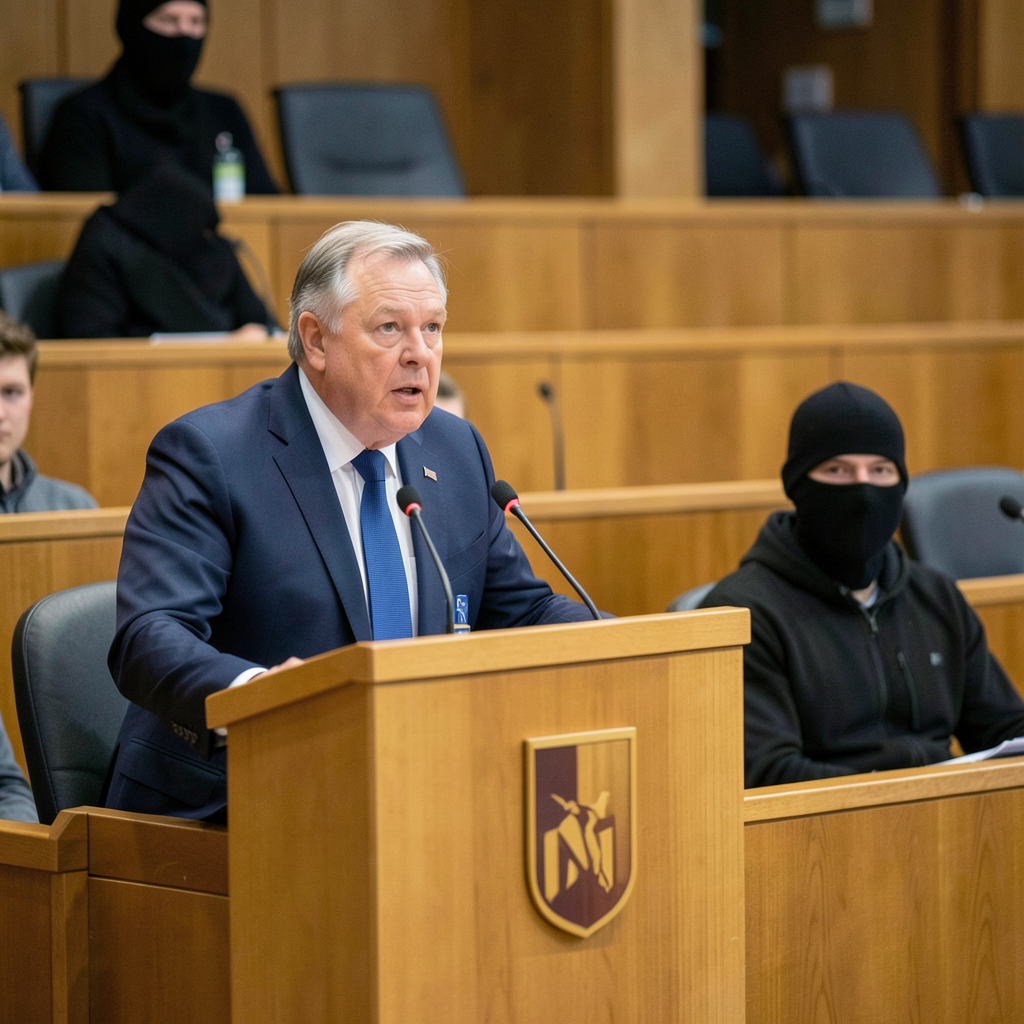

A Senedd short debate on whether full-face coverings conflict with British values was branded shameful by Wales’s deputy first minister, who accused Reform members of dividing communities and undermining religious freedom.
The motion was introduced by Reform MS Jason O’Connell during proceedings on Wednesday, October 21.
O’Connell initially addressed crime and public safety, criticising balaclava-wearing young men riding illegal e-bikes and arguing that their presence made streets feel unsafe.
Discussion then moved towards immigration, the burka and the niqab.
O’Connell accused Plaid Cymru of placing greater emphasis on cultures outside Wales than on Welsh culture.
He maintained that Reform supported religious freedom in all its forms, while insisting that a limit was necessary where such freedom oppressed women and obstructed assimilation into Welsh communities.
O’Connell said numerous countries had already prohibited the burka and argued that the same form of oppression must not become normalised in Wales.
He dismissed allegations that Reform was Islamophobic and racist as tired, ineffective and wildly inaccurate.
Fellow Reform MS Francesca O’Brien backed the proposed ban, describing it as straightforward common sense.
She maintained that face coverings, including the burka, were anti-British, that cultures were not equal, and that importing cultural practices incompatible with integration was at odds with British history and culture.
Shouting was heard from across the Siambr following her contribution.
Reform MS Joe Martin also addressed the issue, stating that the burqa and niqab demonstrated the incompatibility of fundamentalist Islam with western civilisation.
He characterised the coverings as representing oppressive, misogynistic and anti-British ideas.
Deputy first minister Sioned Williams said Reform members were deliberately setting communities against one another to gain political advantage.
She questioned who had the authority to determine Britishness or Welshness and whether a woman wearing a face covering was therefore less British or less Welsh.
Williams warned that political rhetoric was making Islamophobia increasingly commonplace.
Fflint Wrecsam MS Carrie Harper rejected the connection drawn between the motion and crime, describing it as a thinly veiled assault on women’s religious rights.
She also noted the irony of Reform presenting the debate in terms of values during the same week that an ITV News investigation exposed deep-rooted racism and sexism within the party.
Caerdydd Penarth MS Kiera Marshall said a Muslim woman had been attacked in her constituency because of the headscarf she wore.
She argued that the conduct of Reform’s representatives was producing the same result as their rhetoric.
Labour MS Huw Thomas condemned the debate as nonsense.
He turned to the RNLI and the intimidation recently faced by the organisation’s volunteers, describing the courage and decency demonstrated by RNLI personnel while saving lives in the English Channel regardless of creed, skin colour, race or religion as a true representation of British values.
Williams said she was disturbed by the unsettling sound heard throughout the contributions.
She compared the debate to a dog whistle that had repeatedly pierced political discussions in the chamber since the election in May.
According to Williams, the issue remained over the Reform benches and created an intangible sense that a boundary had already been crossed, leaving many people uncertain about how far it had been breached.
She said she was not afraid to state that the line had been crossed too often since May.
Williams again accused Reform of deliberately pitting communities against each other for political gain, describing the tactic as both shameful and hateful.
She invoked German philosopher and author of The Origins of Totalitarianism Hannah Arendt, who observed that the loss of human empathy is among the earliest and most significant indications of a culture approaching barbarism.
Williams said racism and Islamophobia were becoming increasingly normalised through deliberate political discourse.
Addressing fellow elected members, she said their privileged position gave their words considerable influence and made silence unacceptable.
Her contribution received applause in the Siambr.
No vote was held because Wales does not have the power to prohibit face coverings.
Before the debate, protests took place on the steps of the Senedd in Cardiff Bay, and some assembly members joined them.
The Muslim Council of Wales issued a statement in which it said Wales and Britain faced serious challenges.
It noted that 31% of children in Wales were living in poverty, that the Welsh employment rate remained below the UK average, and that Britain faced increasing threats from abroad.
The organisation described Reform’s decision to use taxpayer-funded debating time for what it called a dog-whistle debate as bizarre.
It described religious freedom as a cornerstone of British values and a deeply rooted Welsh tradition that had, until recently, been embodied by the Senedd and its members.
The Muslim Council of Wales also expressed concern about Reform’s authoritarian approach to civil and personal liberties, stating that the people of Wales deserved better.