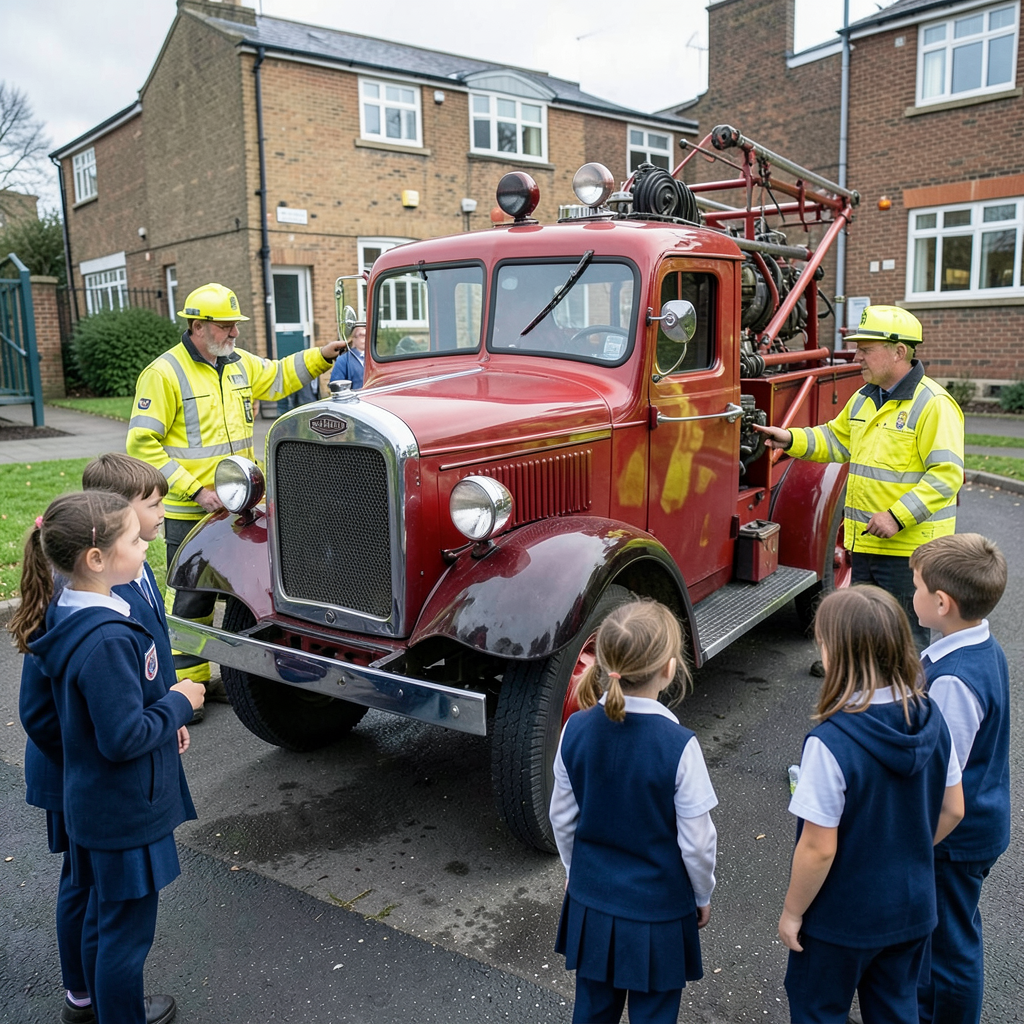

A vintage fire appliance that formed part of the initial emergency response at Aberfan has returned to the village in commemoration of the forthcoming 60th anniversary of the tragedy.
The restored heritage vehicle travelled to Ynysowen Community Primary School, where students examined the appliance and engaged with firefighters from South Wales Fire and Rescue Service.
Educational sessions at the school focused on the critical functions performed by emergency personnel during the aftermath of the catastrophe.
Personnel from White Watch at Merthyr Fire Station accompanied the historical vehicle and brought contemporary firefighting equipment for demonstration purposes.
Students, educators and school employees participated in the event alongside Henry Cotton, the private collector who oversaw the restoration and preservation of the appliance in collaboration with the Norfolk Fire Museum.
The vehicle had previously served from the Merthyr Tydfil fire station.
Firefighter Sam Gill stated that transporting the appliance back to Aberfan had proved profoundly emotional.
The visit aimed to assist younger generations in comprehending the bravery, empathy and collective resolve demonstrated during circumstances of immense suffering.
Those responding to emergencies remain committed to safeguarding and assisting communities across Wales.
Councillor David Isaac, civic head of Merthyr Tydfil, noted that witnessing the historic fire engine visit the school and interact with students who gained insight into its association with Aberfan had been a meaningful occasion.
As one of the earliest emergency service vehicles to reach the location on that day in 1966, the appliance served as a testament to the heroism and communal solidarity displayed amid overwhelming tragedy.
Ensuring such narratives continue to be transmitted to subsequent generations was considered essential.
South Wales Fire and Rescue Service indicated that institutional knowledge gained from significant incidents over the intervening years, including Aberfan, had informed contemporary operational protocols for emergency response.
Assistant Chief Fire Officer Matthew Jones noted that although equipment and technological capabilities had undergone substantial evolution, the obligations borne by those responding to emergencies had remained constant, as had the guiding principles underlying such responses.
Bravery, compassion and dedication retained their significance just as they had in 1966.