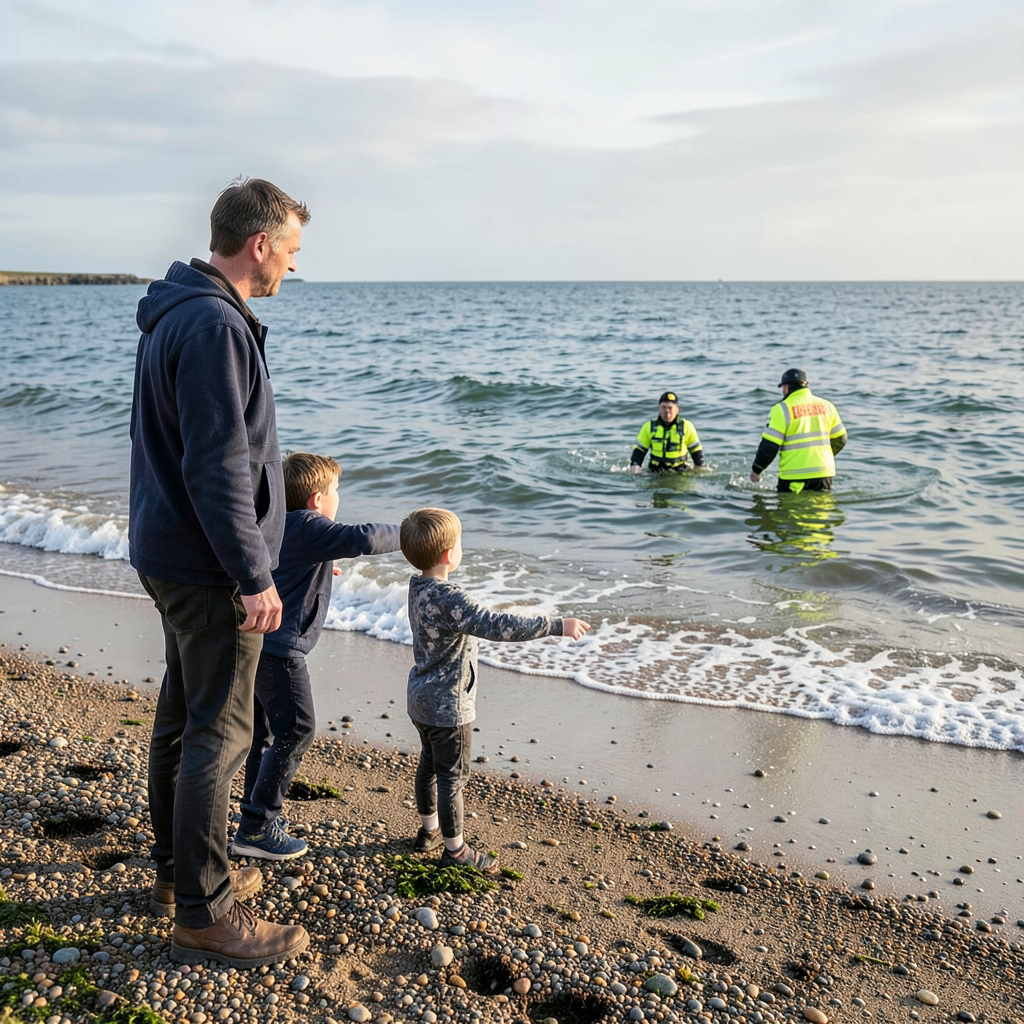

A child with autism and global development delay has been commended for his role in preventing a potential tragedy off the south Wales coastline.
The boy identified two youngsters struggling in the sea and immediately alerted his father, enabling emergency services to respond and bring both individuals safely to land.
The incident occurred when the child and his father were spending time together at a beach location near the Captain’s Wife public house in Sully.
The father, whose given name is Ash, observed his son communicate a concern about two other boys who appeared to be in difficulty in the water.
The child’s condition typically presents significant barriers to verbal communication, often preventing him from initiating conversations or drawing attention to his surroundings.
Despite these challenges, he chose to speak up on this occasion, which his father recognised as an indication that something was seriously amiss.
Upon looking toward the water, Ash confirmed that one of the stranded boys had water reaching his chest as he fought against a powerful current while attempting to return to the shore.
The incoming tide was creating increasingly treacherous conditions.
Ash promptly contacted HM Coastguard and remained on the telephone while rescue teams coordinated their response.
The D-class inshore lifeboat from Barry Dock RNLI was dispatched to the scene, where two boys had been caught out by rapidly rising water levels and strong tidal flow.
Throughout the operation, which unfolded after nightfall, Ash and his son remained on the beach and witnessed volunteers from the lifeboat service reach the boys and guide them safely to shore.
Ash later described his pride in his son’s actions, noting that given his considerable communication difficulties, the awareness his child demonstrated and his willingness to raise the alarm came as both a surprise and an inspiration.
Ash recalled looking toward the island and recognising the severity of the situation, prompting his immediate call for professional assistance.
He expressed relief that his son had spoken up when he did, believing the outcome could have been far worse without that intervention.
The recognition his son received from the RNLI was thoroughly deserved, according to Ash.
Following the incident, personnel at Barry Dock RNLI learned of the child’s involvement and extended an invitation for him and his father to visit their station.
During the visit, the boy received an exclusive tour of the facility, explored both the all-weather lifeboat and the smaller D-class vessel, and encountered several members of the volunteer team.
Among those who met him were station Coxswain Andy Gavan, workshop mechanic Jules, a visiting mechanic named Ed who had travelled from the Isle of Man, volunteer crew member Nick, and press officer Lisa.
The crew presented the child with a certificate acknowledging his attentiveness and his decision to alert his father when he recognised the two boys were in trouble.
The RNLI emphasised that for someone who typically finds verbal expression difficult, the child’s choice to communicate what he had observed carried particular significance.
From the crew’s perspective, the visit offered an opportunity to acknowledge an individual whose actions had created meaningful change.
Coxswain Andy Gavan from Barry Dock described the boy as an exemplary young person and expressed the crew’s pleasure at welcoming him and his father to the station.
Gavan explained that what distinguished this particular account was the child’s ability to notice something was wrong and ensure his father was informed, recognising that the two boys required assistance and then speaking up accordingly.
The coxswain noted that the organisation frequently discusses the importance of community vigilance along coastal areas, and this case exemplified that principle perfectly.
The father’s prompt notification of emergency services meant help could be dispatched without delay, and the crew wanted the child to understand how much his actions were valued.
Gavan added that showing the visitor around the facility, introducing him to team members, and presenting the certificate proved to be a genuinely enjoyable experience for everyone involved, describing the child as a deserving recipient of recognition.
Coastal safety specialists at the station also used the opportunity to warn visitors about the hazards posed by shifting tides and forceful currents along the south Wales shoreline, particularly in areas surrounding Sully Island where those exploring the coastline can rapidly find themselves cut off from their return route.
Calm sea conditions can prove deceptive, as circumstances may deteriorate quickly, leaving individuals in perilous situations as they attempt to reach safety.
For the volunteer crew at Barry Dock, this incident serves as a reminder that members of the public can contribute to keeping coastal users safe.
Visitors are advised to consult tide timetables before venturing out and to allocate sufficient margin to complete their return before conditions change.
Individuals should remain cognisant that incoming tides can isolate coastal areas from the mainland with surprising speed.
Under no circumstances should anyone enter the water to attempt an independent rescue of another person.
Anyone witnessing someone in distress along the coastline should contact the emergency services by dialling 999 and requesting the Coastguard.
The organisation emphasised that assistance does not require official lifeboat crew status; simply alerting someone with the capacity to help when observing someone in difficulty can prove decisive.