
Throughout Gwent, landscapes exist that transport visitors far beyond their actual location.
From the valleys reminiscent of New Zealand to forests echoing Canada and mountains resembling Japan, these striking destinations in south-east Wales provide international experiences without requiring travel abroad.
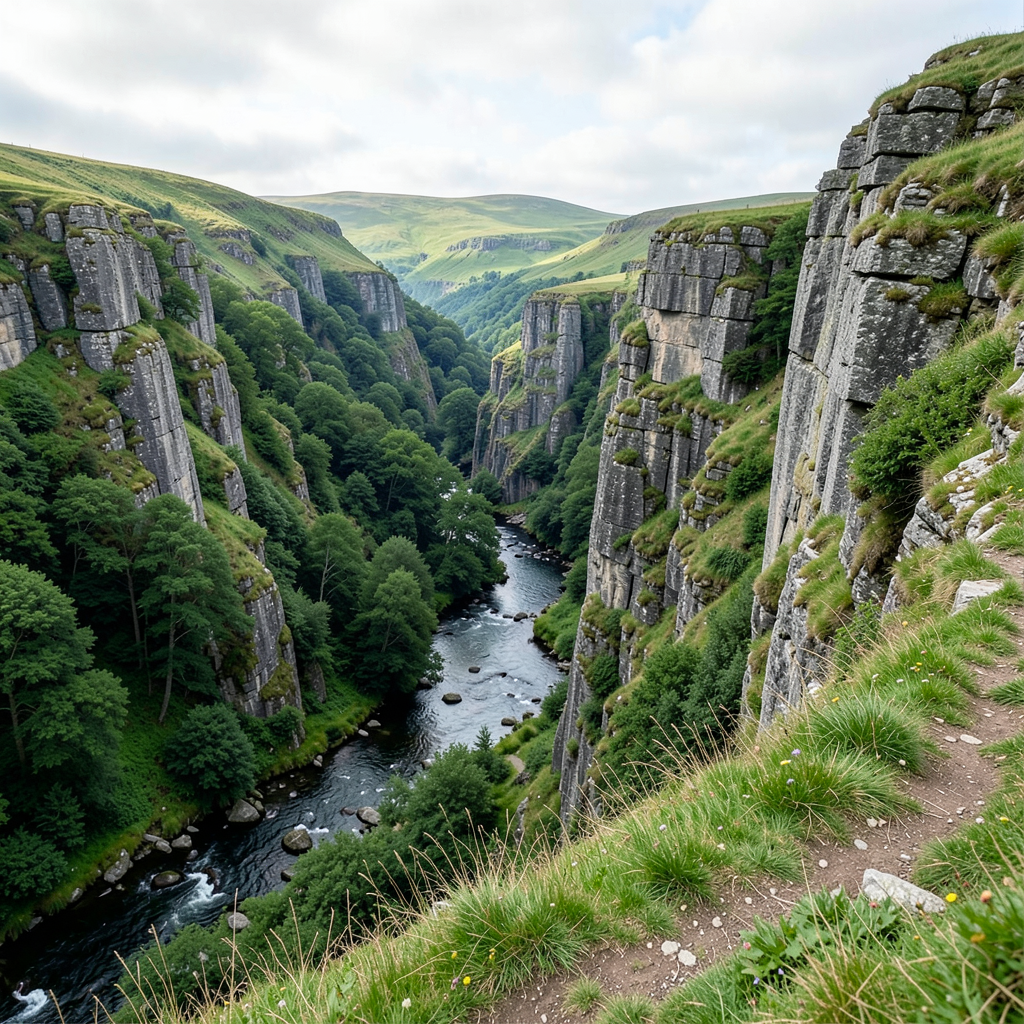
Clydach Gorge bears a striking resemblance to Switzerland.
Situated between Brynmawr and Gilwern, this corridor of south-east Wales presents dramatic terrain.
Towering limestone cliffs, steep forested slopes and tumbling waterfalls create an environment that could easily be confused with a secluded Alpine valley.
The River Clydach has shaped the area over millennia, producing a remarkable natural passage adorned with rock formations, old-growth woodland and flowing water.
Unlike Switzerland’s snow-capped peaks, the gorge remains predominantly verdant, with moss-covered stones and thick vegetation enhancing its character.
The area also carries an industrial heritage, having once contained ironworks, quarries and tramways.
The Clydach Ironworks establishment originated in 1793 and at its height provided employment for 1,350 workers extracting local iron ore, coal and limestone.
Nature has subsequently reclaimed much of the gorge, attracting hikers and photography enthusiasts seeking Alpine scenery without venturing to continental Europe.
Llanthony Valley offers New Zealand qualities.
Nestled within the Black Mountains of Monmouthshire, this tranquil area mirrors New Zealand’s South Island.
Rolling green hills rise from the valley floor while scattered farms and meandering lanes contribute to an atmosphere of seclusion.
Clear conditions reveal expansive vistas that could double for scenes from Middle-earth.
One notable feature is Llanthony Priory, a medieval ecclesiastical site whose impressive remains sit beneath surrounding peaks.
Minimal development and extensive countryside provide genuine escape without global travel.
Offa’s Dyke Path traverses the ridge overlooking the valley.
Wentwood Forest presents characteristics associated with Canada.
East of Newport, this vast woodland represents one of Wales’ most substantial areas of ancient forest.
The broader woodland spans over 1,000 hectares, featuring walking routes, imposing trees and thick undergrowth.
Where coniferous species prevail, the environment takes on a distinctly North American atmosphere.
Long forest pathways vanish between the trees, recalling the forested landscapes of eastern Canada.
The area once formed part of Chepstow Castle’s hunting territories.
Contemporary conservation initiatives work to re-establish native woodland species, positioning Wentwood as both an ecological sanctuary and an attractive destination for exploration.
Tintern Abbey channels French aesthetics.
Positioned along the River Wye, its substantial Gothic remains could belong to a northern French monastery.
Elevated stone arches, detailed windows and tranquil waterside settings share qualities with Normandy’s great medieval religious structures.
Established in 1131 by Cistercian monks, the abbey became among Wales’ most significant religious establishments before declining following the dissolution of monastic institutions.
Its exposed walls stand as a powerful testament to former magnificence.
Encircled by forested hillsides, Tintern proves especially evocative during autumn when changing foliage frames its ancient masonry.
Visitors might readily believe they have discovered a historic French settlement rather than a modest Monmouthshire community.
Keeper’s Pond echoes Norwegian terrain.
Elevated above Blaenavon on the Blorenge, this body of water presents scenery unlike the green valleys typically linked with south Wales.
Encompassed by open moorland, the isolated pond mirrors a distant Norwegian mountain tarn.
During foggy mornings when low cloud traverses adjacent hills, the vista acquires a particularly Scandinavian quality.
Its exposed position and scarcity of woodland enhance this impression.
However, Keeper’s Pond is artificial, constructed during the early 1800s to provide water for Garnddyrys Forge.
Now a frequently used departure point for Blorenge excursions, it provides remarkable panoramas across the surrounding landscape.
The Wye Valley bears similarities to Germany.
Its meandering river, tree-covered slopes and observation points evoke Germany’s Rhine Valley.
The River Wye flows through terrain of steep inclines and thick woodland, producing impressive views entirely appropriate to German countryside.
Like the Rhine, the valley pairs natural splendour with historic villages, ancient structures and fortresses overlooking the water.
Some of the most remarkable panoramas appear along the wooded stretches near Tintern and the celebrated viewpoints commanding views of the river.
During autumn, when hillsides adopt orange and golden hues, the parallel intensifies considerably.
Visitors might readily imagine themselves discovering a peaceful German river valley despite remaining mere distance from Newport.
Pwll Du presents characteristics of Iceland.
While much of Gwent features green hills and forested valleys, Pwll Du delivers something distinct.
Within the uplands above Blaenavon, Pwll Du’s barren, exposed terrain brings Iceland to mind.
Its open stretches without trees, rocky ground and dramatic skies generate an atmosphere of considerable remoteness.
When mist descends over the hills, the scenery becomes yet more atmospheric, with minimal features disrupting views across exposed moorland.
Unlike Iceland’s volcanic formations, Pwll Du’s character stems substantially from industrial heritage.
The surrounding Blaenavon Industrial Landscape, designated a UNESCO World Heritage Site, contains remnants of former mines, quarries and transport infrastructure.
This represents landscape moulded as much by human endeavour as natural forces, and one of south-east Wales’ most exceptional areas for investigation.
The Sugarloaf carries Japanese associations.
Though Monmouthshire may appear distant from Japan, one of its prominent peaks possesses a recognisable profile.
Rising above Abergavenny, the Sugarloaf is renowned for its nearly conical shape.
From particular vantage points, its solitary summit mirrors Japan’s Mount Fuji.
At 596 metres elevation, the Sugarloaf falls considerably short of the Japanese mountain and lacks volcanic origin.
Nonetheless, its pointed peak and prominent position above surrounding terrain produce an unmistakable silhouette.
The mountain proves particularly striking when observed from distance, especially during early morning or late afternoon illumination.
For those contemplating Mount Fuji, the Sugarloaf provides a considerably more reachable option.
Those undertaking the ascent receive sweeping vistas across the Black Mountains and beyond as their prize.