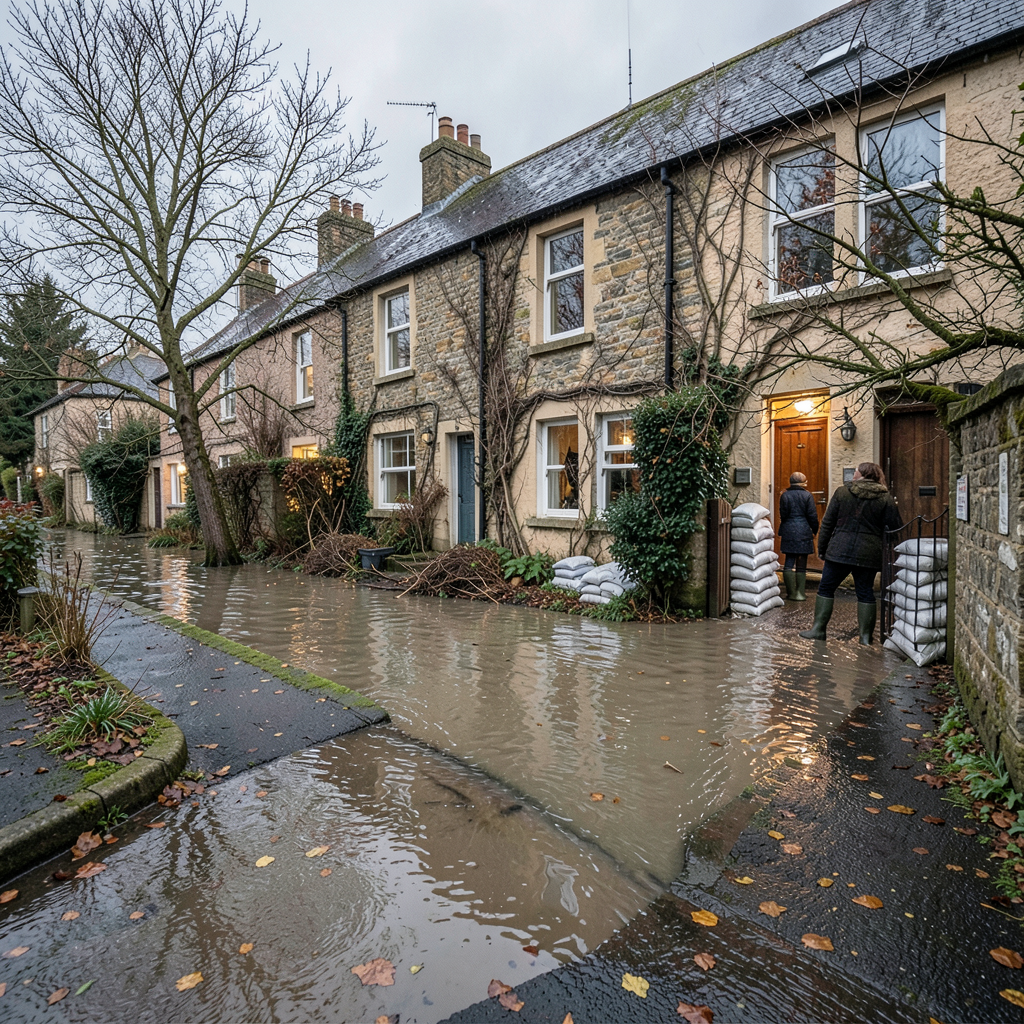

Communities across Wales face increasing flood risks as climate patterns shift, prompting calls for a comprehensive approach to emergency preparedness that combines traditional engineering with natural solutions.
The village of Tal-y-bont in Ceredigion illustrates both the devastating impact of sudden flooding and the potential for community-led resilience.
On 9 June 2012, a single day brought rainfall equivalent to an entire month’s average, submerging 27 residences and leaving lasting damage to the area.
Years after this event, local residents remained acutely aware of their continued vulnerability, prompting decisive collective action.
The Talybont Floodees group, coordinated by Linda Denton, mobilised a diverse coalition of residents, students, landowners and volunteers spanning ages from 15 to 75.
Over multiple winter seasons, the group undertook extensive tree planting across the elevated terrain above the settlement and constructed willow dams engineered to impede water flow through the surrounding landscape.
Rather than attempting to halt water entirely, the initiative aims to decelerate downstream movement and minimise the volume reaching the village during intense rainfall.
This approach requires considerable patience, as woodland takes years to reach maturity, and its effectiveness varies according to terrain characteristics, intervention scope and meteorological conditions.
Ceredigion County Council has recognised the group’s efforts and established a collaborative flood protection partnership with the community, demonstrating how governmental bodies and local populations can coordinate effectively.
The broader context reveals significant challenges across Wales.
Natural Resources Wales calculations indicate approximately 275,000 properties face potential flooding, yet official data suggests only a limited proportion of those entitled to flood notifications have activated such alerts.
Beyond individual readiness, structural community preparedness represents an essential but underdeveloped priority.
In Cardigan, householders and enterprises located near the River Teifi have collaborated on formulating shared emergency protocols, establishing clear communication channels and mutual assistance arrangements activated when warnings are issued.
The town’s civic leader has installed protective measures at her personal residence, demonstrating commitment through direct action.
Similarly, Pontcanna in Cardiff has created a neighbourhood flood strategy addressing anticipated rises in River Taff levels, alongside an online repository offering document templates and planning frameworks accessible to other groups seeking to develop similar arrangements.
Scotland provides an instructive comparison, with over 300 active community resilience organisations supported by materials enabling local risk assessment, identification of vulnerable individuals, contact network organisation and predetermined emergency response procedures.
The National Flood Forum, a UK-wide body offering guidance and assistance to flood-threatened communities throughout all phases of emergency events, has received formal engagement from the Welsh Government to formulate recommendations for establishing a dedicated Welsh Flood Forum.
Such an institution would facilitate local flood group formation, plan development and knowledge exchange while bridging connections between householders and technical expertise or statutory authorities.
Nevertheless, reliance solely on volunteer coordination risks excluding those lacking spare capacity, energy or financial means to organise in their personal time.
Sustainable financing, operational assistance, skills development and explicit accountability assigned to local authorities and partner agencies remain essential prerequisites.
Contemporary thinking increasingly recognises that engineered infrastructure alone cannot address flood vulnerability comprehensively.
Flood prevention debates have historically concentrated on constructed barriers, walls and drainage networks, which retain necessity in many contexts protecting residences, highways and critical facilities.
However, ecosystem restoration including wetland rehabilitation, peatland recovery, strategic tree and hedgerow establishment, soil condition enhancement and river-floodplain reconnection can retain water and moderate surface runoff across entire drainage areas while simultaneously delivering ecological and water quality improvements.
The critical requirement involves transitioning from discrete initiatives to sustained, catchment-wide programmes underpinned by enduring public investment, systematic evaluation and coordinated participation among councils, agricultural businesses, landowners, neighbourhoods and conservation bodies.
Land managers deserve appropriate compensation for implementing practices generating broader societal advantages.
Natural and structural interventions function most effectively when integrated within coherent strategies tailored to specific geographical circumstances.
Whatever approach predominates, public authorities must retain ultimate accountability rather than deflecting obligations onto unpaid contributors.
Households facing particular disadvantage during emergencies, including elderly residents, those with disabilities, solitary occupants, families with young children and individuals lacking private transport, require targeted consideration.
Accessible alert mechanisms, comprehensible guidance, community support networks and practical help for those unable to independently implement protective measures constitute essential elements of any adequate response.
Welsh preparedness requirements encompass four fundamental components: an adequately resourced Welsh Flood Forum enabling community readiness; an intensive campaign to expand flood warning subscription rates; sustained financing for natural flood management integrated with conventional engineered protection; and emergency strategies prioritising vulnerable populations.
No combination can guarantee complete prevention, yet meaningful reductions in avoidable suffering, improved community recovery capacity and diminished severity of future incidents remain achievable objectives.
The cautionary signals have been issued.
While meteorological uncertainty precludes precise prediction of imminent conditions, the window for meaningful preparation remains open.
Waiting for catastrophe to expose deficiencies represents the poorest possible approach.
Preparation must commence immediately and persist throughout the seasons ahead.