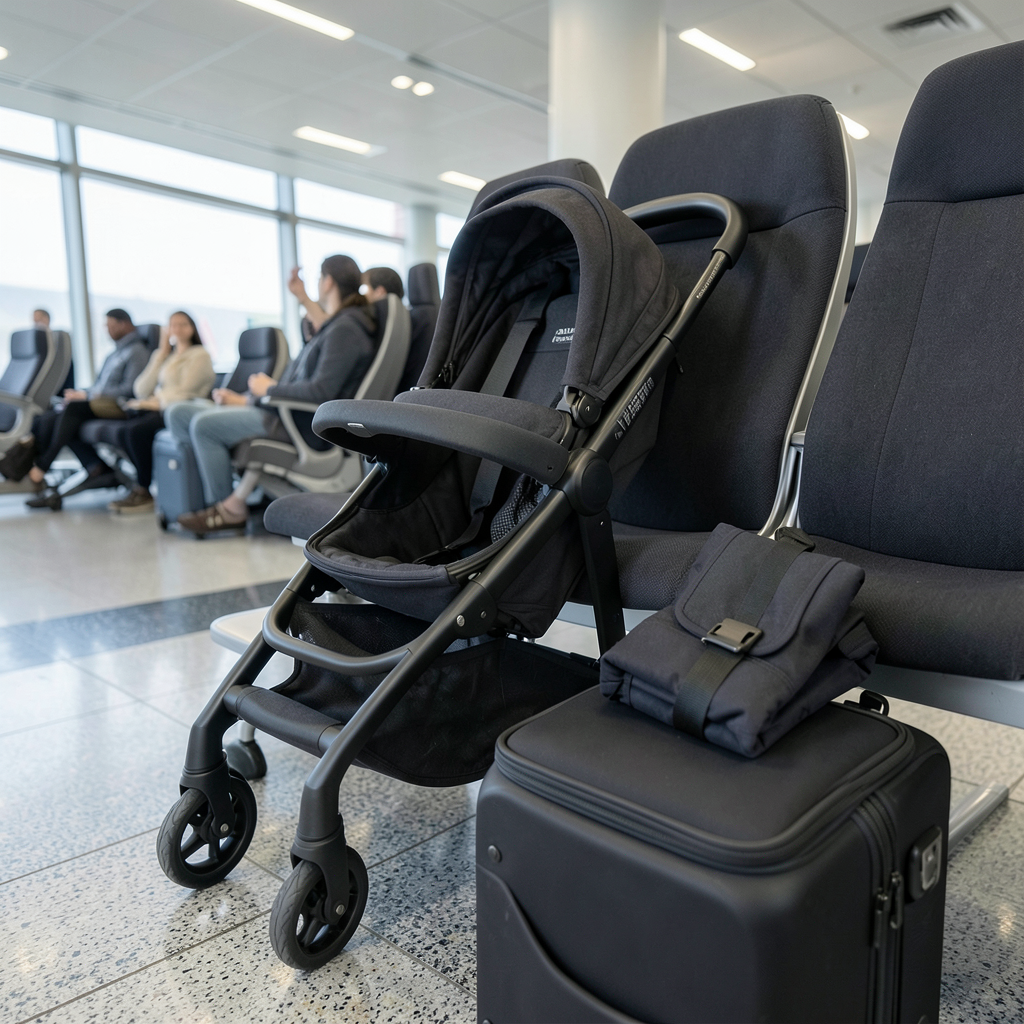

Stokke has released the latest iteration of its popular compact pushchair, skipping an entire generation by moving directly from the YOYO 3 to the YOYO 5.
The Norwegian manufacturer has implemented a range of incremental refinements to its lightweight travel stroller, addressing several pain points identified in the previous model while maintaining the practical qualities that have made the range a favourite among travelling families.
The YOYO series has established itself in a unique market position, occupying the middle ground between traditional pushchairs and ultra-portable travel strollers.
The availability of different packs, including a Newborn Pack option, enables the pushchair to serve families from birth through toddlerhood.
This flexibility provides much of the comfort and functionality associated with conventional pushchairs without the bulk and weight typically accompanying such designs.
Airport compatibility has long been a selling point for the YOYO range.
The compact folded dimensions allow the pushchair to be stored in overhead lockers on numerous aircraft, subject to individual airline policies.
Parents travelling with young children can bypass the delays associated with gate-checked luggage and hold-allotted pushchairs, instead deploying the stroller within minutes of disembarking.
The most significant modification appears in the seat unit.
Testing alongside a toddler approaching two years of age provided a clear basis for comparison between the YOYO 3 and YOYO 5 configurations.
The newer model features a noticeably wider seat with additional cushioning and improved overall support.
The seating position places the child in a more upright posture, addressing a previous issue where occupants could gradually slide downward during use.
The recline mechanism has also been overhauled, replacing the side-to-side toggle arrangement with a more straightforward single-strap and clip system that simplifies adjustment considerably.
Head support has received similar attention.
The previous cushion design, despite its thickness, sat too elevated and proved prone to displacement.
The YOYO 5 incorporates a larger cushion positioned more appropriately, secured in place by the shoulder straps to prevent unwanted movement.
The combined effect of enhanced seat dimensions, improved cushioning and better recline functionality creates a substantially more comfortable environment for the child.
Folding mechanics have been refined further.
Stokke describes the system as a one-handed, single-action operation, and the mechanism does feel more intuitive than its predecessor.
Positioning the handlebar to the left before engaging the release button produces the most reliable results, though pushing to the right with corresponding unlock indicators is equally viable.
The redesigned locking mechanism results in marginally increased folded height compared to the YOYO 3, though the new footrest design functions as a stable stand, creating a neater storage footprint.
The harness configuration has been modified to address previous frustrations.
The YOYO 3 required two buckle sections to be connected before insertion into the primary fastening, with components prone to separating during wriggly moments.
The YOYO 5 introduces a four-part buckle system allowing each shoulder and leg section to be secured independently, reducing the complexity of managing a reluctant toddler.
Canopy modifications include an enlarged observation window, repositioned ventilation offering improved airflow around the head area, and greater flexibility in extension positions.
Previous iterations essentially offered binary open or closed states, whereas the YOYO 5 provides intermediate settings.
The canopy material demonstrates enhanced water resistance, a practical consideration for British weather conditions.
Storage provisions remain present, with a compartment behind the seat and an undercarriage basket continuing to serve as primary options.
Access to these storage areas feels more straightforward in the updated design, representing a practical rather than revolutionary refinement.
Ride quality inevitably reflects the compact nature of the vehicle.
Smaller wheels and a lightweight frame transmit more surface feedback than larger prams would, a characteristic inherent to portable designs.
Suspension modifications, while not visually conspicuous, appear to compress the vibration pattern over rough terrain, producing shorter, quicker jolts rather than prolonged oscillation.
The handlebar delivers a smoother grip experience with a marginally firmer feel, potentially contributing to heightened pushing sensitivity.
Overall handling maintains the agility and manoeuvrability expected from the range, performing admirably through retail environments, crowded streets and airport terminals.
For prospective purchasers weighing options between generations, the YOYO 5 does not represent a fundamental reimagining.
The previous model remains a capable product, and significant discounts on remaining YOYO 3 stock may present compelling value.
Existing YOYO 3 owners content with their purchase face no urgent imperative to upgrade.
However, those acquiring their first YOYO with budget permitting would benefit from the accumulated refinements, particularly families anticipating regular utilisation as their child develops.
Accessory availability extends the product’s lifespan, with options including footmuffs, hand warmers and snow skis expanding functionality across seasons.
Configurable packs and supplementary items allow customisation to individual family requirements.
The YOYO 5 retains the core attributes defining its predecessors: lightweight construction, compact proportions and practical functionality for both local excursions and international travel.
Enhanced seat dimensions, improved head support positioning and the more intuitive folding mechanism elevate the overall experience without sacrificing portability.
Certain compromises persist, including the inherent trade-off between wheel size and ride quality, alongside the directional folding sensitivity.
These limitations remain minor considerations against the substantial practical advantages offered by the revised design.
Stokke has opted for evolution rather than revolution, taking an already accomplished product and systematically addressing accumulated user frustrations.
The result is a more refined package that successfully bridges the gap between travel stroller convenience and pushchair comfort.