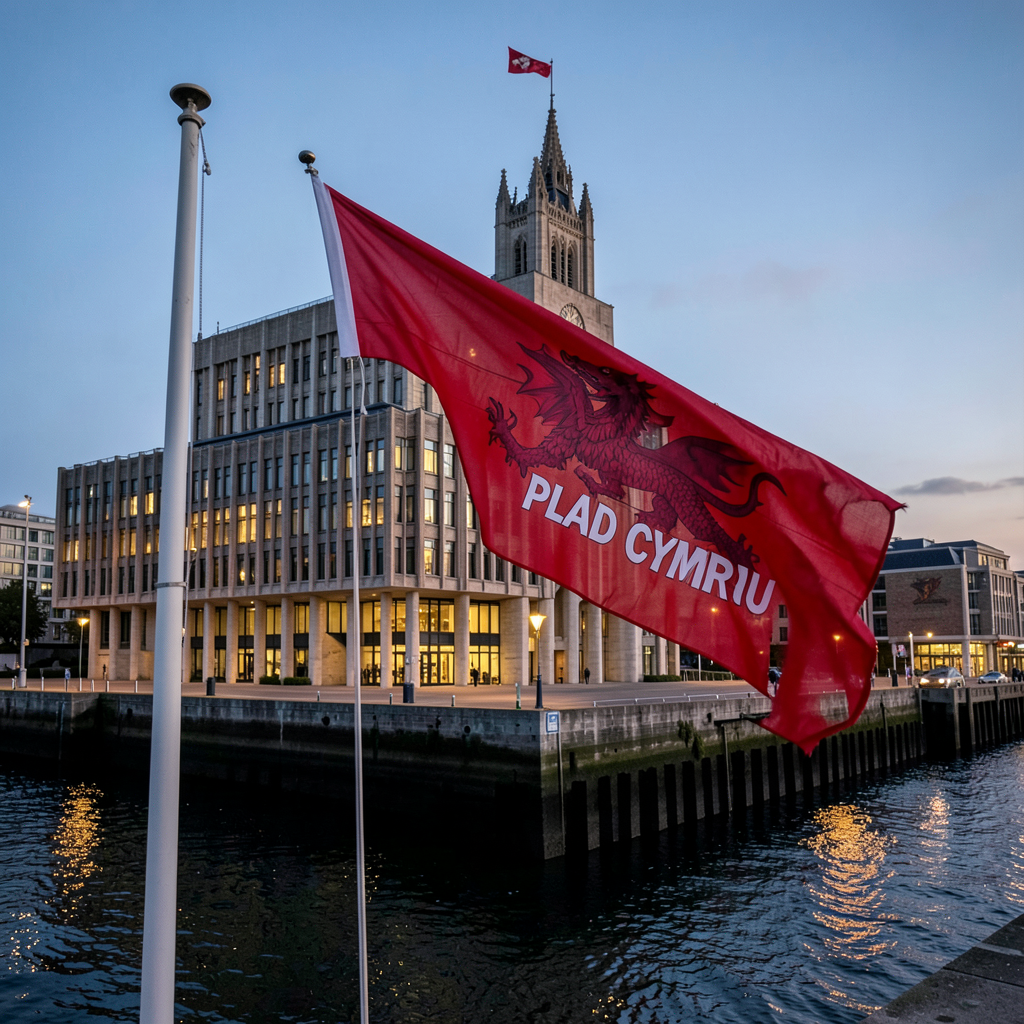

A fresh electoral modelling exercise has indicated that Wales could undergo a fundamental reshaping of its parliamentary representation, with one nationalist party and one insurgent movement poised to control the vast majority of constituencies while the dominant force of recent decades faces an unprecedented collapse in support.
The YouGov constituency-by-constituency analysis, the first such exercise since the current Prime Minister took office, suggests Plaid Cymru would secure fifteen of Wales’ thirty-two Westminster seats under the central scenario.
This would constitute the nationalist party’s highest ever haul at a UK-wide election, with the model’s projections reaching as high as eighteen seats in more optimistic scenarios.
The same modelling places Reform UK ahead in fourteen constituencies.
However, the incumbent administration would retain only two seats according to the central estimate, a result that would represent the party’s poorest performance on Welsh soil since the early twentieth century.
The Conservative Party would claim the single remaining seat.
The methodology underpinning these projections employs extensive national polling data combined with demographic profiling to generate likely outcomes in individual constituencies without the need for separate local surveys.
This technique enables seat-level forecasting that would be prohibitively expensive through traditional polling approaches.
Despite Reform’s apparently dominant position in the constituency estimates, the party’s underlying polling trajectory tells a different story.
Support for the movement at UK-wide level has fallen sharply, with recent surveys placing the party seven percentage points lower than its May position.
During the same period, Labour has recovered ten points, while Plaid comfortably leads both with more than a quarter of the vote.
The collapse in Reform’s headline figures preceded significant internal upheaval in Wales, including the departure of the party’s regional leader and a defection to Plaid Cymru.
Whether these developments have further damaged support remains unmeasured by current polling.
Within the constituency-level projections, many of Reform’s apparent victories rest on fragile foundations.
Seven of the fourteen leads are margin of five points or less.
One seat appears effectively balanced between candidates, while others show advantages of one or two points.
Several constituencies display larger but still contestable leads of two to five points.
The broader UK picture reveals a similar pattern.
While Reform leads in one hundred and twenty-three seats according to the central estimate, nearly seventy percent of those victories are separated by five points or fewer from nearest rivals.
Such narrow margins leave a substantial proportion of projected gains vulnerable to modest shifts in public intention.
The potential for tactical coordination adds another layer of complexity.
Research indicates that a significant majority of supporters for smaller opposition parties would consider switching allegiance to prevent Reform from winning in constituencies seen as direct contests between that movement and Labour.
The situation in Wales differs somewhat because the closest races frequently involve Plaid rather than Labour.
One constituency shows the nationalist party holding a single-point advantage, while another demonstrates a tie at twenty-seven percent between Plaid and Reform.
The modelling suggests Plaid would emerge victorious across a wide geographic spread, including constituencies in the south Wales Valleys traditionally considered Labour territory.
These would include former heartlands of the Labour Party stretching from the valleys communities through to parts of Swansea and Cardiff.
Reform would lead across much of the north-east while also projecting strength through seats extending from Pembrokeshire to Newport.
One striking feature concerns the divergence between Labour’s apparent national recovery and its continued weakness in Wales.
The same polling organisation’s UK-wide estimates show Labour substantially improving its position since the Prime Minister entered government.
However, the Welsh projection of just two seats falls below even the modest three-seat forecast produced in previous modelling conducted before the current administration took power.
That deterioration mirrors findings from Welsh-specific polling, which recorded Labour’s Westminster support climbing significantly from its May low but remaining considerably weaker than the party’s showing in Senedd preference surveys.
The constituency estimates expose particular difficulties for senior government figures.
One cabinet minister’s seat shows the party trailing both leading contenders by substantial margins.
Another prominent position held by a Northern Ireland secretary displays a similar pattern of third-place finish behind the nationalist and insurgent parties.
Analysts specifically flagged both ministers among those trailing rivals in the central scenario.
The party’s retained seats, while better than the broader Welsh picture suggests, still reflect narrow advantages.
One retained constituency shows only a three-point lead, while another coastal seat displays the same margin.
Across all parties, fifteen of the thirty-two constituencies feature margins of five points or fewer.
The modelling also highlights the growing distinction between electoral behaviour at UK and devolved levels.
Plaid’s dominance in the Welsh Parliament elections contrasted sharply with the more fragmented picture emerging at Westminster level.
The same polling organisation’s recent research demonstrated this divergence, with markedly different preference patterns between the two electoral systems.
The methodology carries important caveats.
The estimates differ fundamentally from traditional constituency polling, and individual seat projections carry substantial uncertainty, particularly where margins are tight.
The approach also acknowledges that local factors and candidate personalities can prove difficult to model accurately.
These warnings carry particular weight given that almost half the Welsh seats in the central estimate feature margins of five points or fewer.
Relatively minor movements in voting intention could therefore produce substantially altered seat counts for each party.
Nevertheless, the projections offer additional evidence that political transformation in Wales extends well beyond the devolved arena.
Plaid now contests seats where Westminster success once seemed implausible, while Reform maintains leads across diverse territory despite declining support.
Labour’s broader recovery has yet to restore its traditional dominance in Welsh parliamentary politics.