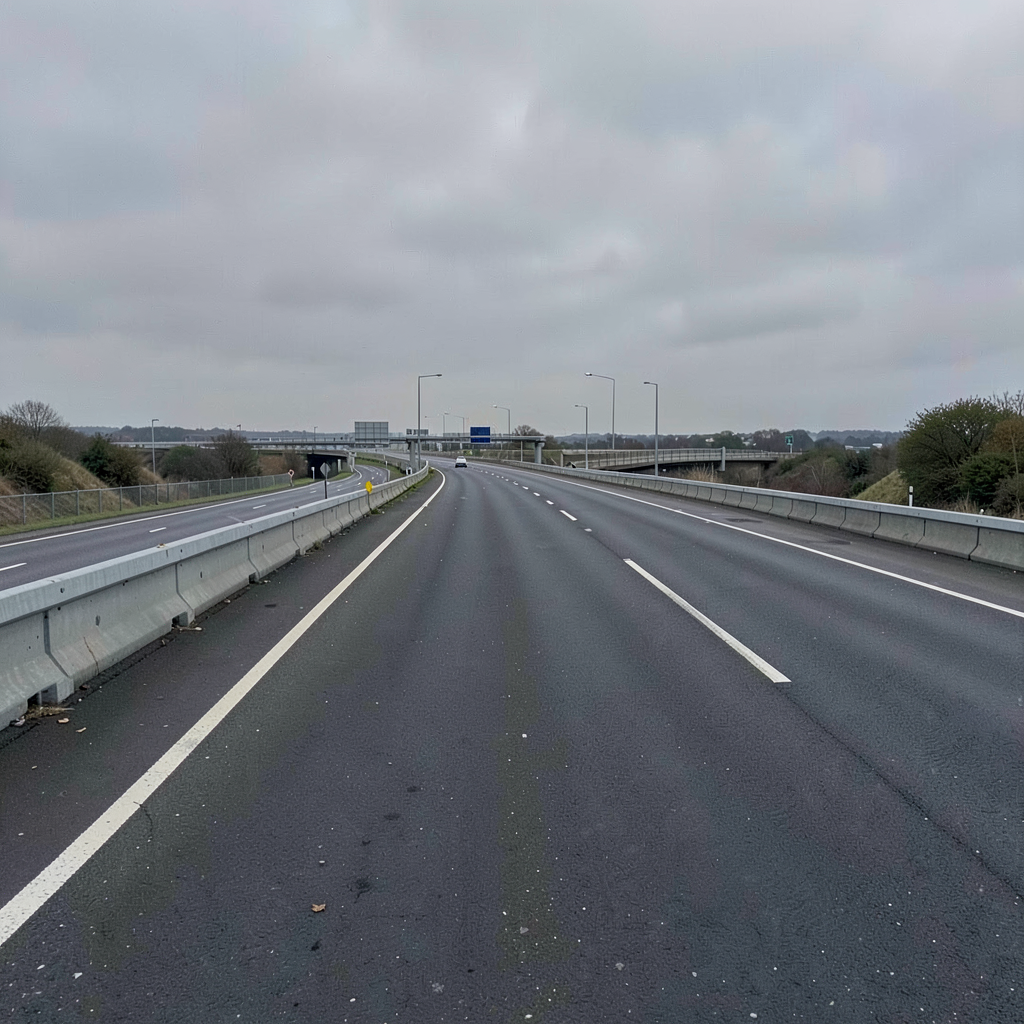

Traffic congestion on the M4 motorway presents ongoing difficulties for drivers travelling between England and Wales.
Motorists frequently experience significant delays near Newport, and the absence of such hold-ups is considered unusual.
The Welsh Government’s consideration of closing motorway junctions in the Newport area as a cost-effective replacement for the abandoned relief road has attracted scrutiny.
Critics contend that such measures would primarily benefit through-traffic while shifting bottlenecks into the city itself.
Transport Deputy Minister Mark Hooper, speaking exclusively to the Argus, indicated that no final determination had been reached while declining to eliminate junction closures from consideration.
Addressing the Senedd in June, the minister acknowledged that the M4 corridor through Newport represented an outstanding and significant problem, with congestion, inconsistent travel times and substandard air quality continuing to impact residents, enterprises and local communities throughout the region.
These concerns are legitimate, though the mechanism by which closing junctions would address them remains unclear.
While journey times for transit traffic might improve, the underlying issues affecting those living and working in Newport would persist if congestion simply relocates to local roads.
The minister pointed to the Burns commission as providing substantial evidence and a set of recommendations, asserting government dedication to full implementation.
The commission’s report, however, did not propose junction closures.
Its data indicated that between roughly 3,000 and 5,000 vehicles traversed each junction in both directions during peak hours.
The analysis determined that achieving reliable journey times near the tunnels would require approximately one-fifth of peak-period trips to be eliminated or transferred to alternative transportation.
The Welsh Government’s approach to meeting these targets apparently involves restricting Newport residents’ motorway access.
While this might decrease overall journey numbers, it carries potentially substantial consequences for Newport and the broader Welsh economy.
Such a policy would diminish connectivity to employment centres for residents of Wales’ fastest-growing urban area.
Newport hosts one of the United Kingdom Government’s designated key industrial clusters, centred on semiconductor manufacturing, which has expanded partly due to its strategic position between Bristol and Cardiff.
Workers commuting to facilities including the Grange, Gwent Police headquarters and other significant employers rely on the M4 for access.
City council leader Dimitri Batrouni has cautioned that substantial traffic redirection onto Newport’s road network could amplify congestion, pollution and strain on residential areas and infrastructure.
Newport East MP Jess Morden described the proposal as potentially catastrophic.
The analytical foundation for junction closures appears incomplete.
The concept surfaced in 2017 as part of objections to the relief road proposal.
Earlier work on potential solutions was conducted in 2011, though fifteen years have elapsed and numerous circumstances have evolved, including Newport’s population growth.
Existing studies do not illustrate the implications for Malpas Road or the Southern Distributor Road under any specific closure scenario.
The government has not specified which junctions might be affected.
Should relevant modelling exist, transparency demands its publication.
Without such analysis, the viability of the proposal remains questionable.
The Burns commission observed that private vehicles maintain particular prominence for travel within Newport, despite more than a quarter of households lacking car ownership.
While expanding public transport usage represents a worthwhile objective, the feasibility of such a fundamental behavioural transformation requires scrutiny.
Restricting motorway access risks constraining Newport’s expansion for the convenience of travellers bound for Cardiff and further destinations.