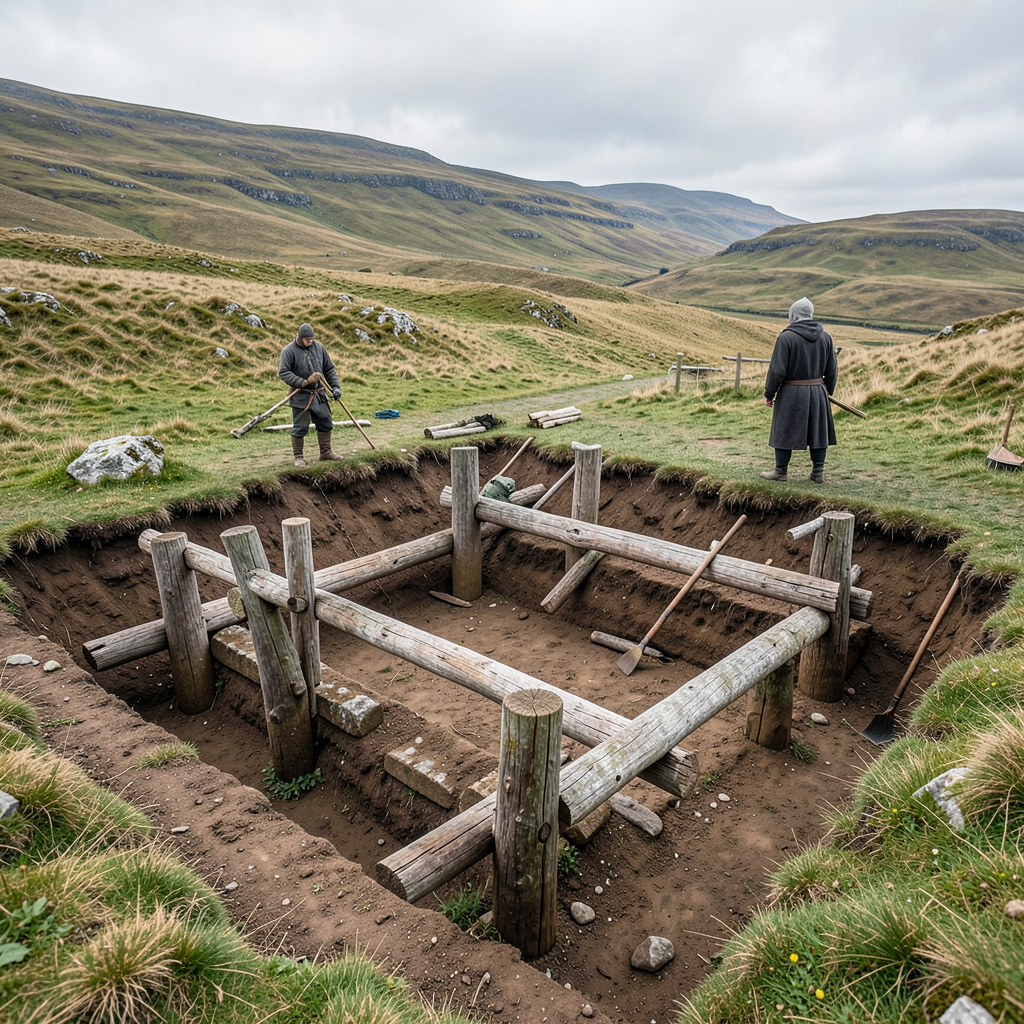

Archaeologists have identified a Roman wooden fort on Y Frenni Fawr in the Preseli Hills of Pembrokeshire, south-west Wales.
The discovery has renewed interest in a medieval narrative associated with the site and raised questions about the extent to which traditional stories can preserve knowledge of vanished places and events.
The narrative appears in *Breuddwyd Macsen Wledig*, also known as *The Dream of Macsen Wledig*.
It recounts the journey of a Roman emperor to Wales and was formerly regarded largely as a medieval invention.
Evidence uncovered on the Pembrokeshire hill, however, suggests that the text may draw upon memories of an identifiable Roman location.
*Breuddwyd Macsen Wledig* belongs to the 11 medieval Welsh-language tales traditionally known collectively as the *Mabinogion*.
Their contents combine historical material, folklore, magic and legend.
Kings, warriors, enchanters and supernatural beings appear in accounts that illuminate how medieval Welsh communities interpreted both their past and the wider world around them.
Two Welsh-language manuscripts contain the tales.
*Llyfr Gwyn Rhydderch*, translated as the *White Book of Rhydderch*, was assembled around the middle of the 14th century, while *Llyfr Coch Hergest*, or the *Red Book of Hergest*, was produced towards the century’s close.
Five of the 11 narratives feature Arthur, the legendary warrior whose deeds eventually circulated across Europe.
*The Four Branches of the Mabinogi* covers landscapes in Wales, Ireland and England, as well as settings in the physical world and a supernatural otherworld.
The other two narratives, one of which is *Breuddwyd Macsen Wledig*, reinterpret aspects of early British history through native forms of storytelling.
Across the collection, power and political authority are recurring subjects.
Within *Breuddwyd Macsen Wledig*, a Roman emperor encounters a woman in a dream and becomes determined to find her.
Messengers are sent along the route seen in the vision, eventually travelling across Europe to present-day Caernarfon in north-west Wales.
The emperor is known as Macsen Wledig, meaning Macsen the Leader.
Macsen is a literary composite rather than a direct portrait of one individual.
His most prominent historical model is Magnus Maximus, a Roman general from Galicia who became emperor in the late 4th century.
Born in a territory that now forms part of Spain and Portugal, Magnus Maximus seized control in Britain and subsequently governed much of the western Roman empire, including Gaul, corresponding broadly to modern France and neighbouring areas.
Magnus Maximus has a particularly enduring place in Welsh history.
Dafydd Iwan’s song *Yma o Hyd*, first released in 1983, invokes the emperor’s departure from Britain and presents it as the abandonment of Wales as a nation.
The song connects with a substantial literary tradition in which Rome’s withdrawal shortly before the English arrival contributed to the formation of Welsh identity.
As with the song, the medieval narrative combines elements of remembered history with imaginative reconstruction.
The tale’s central importance lies in its representation of historical understanding, irrespective of whether every episode occurred as described.
Elen Luyddog, or Elen of the Hosts, is the woman Macsen sees in his dream.
She is similarly constructed from multiple historical figures, including Helen of Caernarfon and Helena of Constantinople, the mother of Constantine the Great.
Both women were recognised as saints in the 4th century.
Elen requires Macsen to travel to Wales before she will marry him.
He accepts her condition, after which she becomes empress.
Her father is appointed viceroy of Britain, and the couple begin constructing major fortresses.
At Elen’s request, Macsen establishes Caerllion, identified with Caerleon; Caerfyrddin, identified with Carmarthen; and Caernarfon.
She further directs him to construct roads connecting these settlements.
The principal Roman road network running between northern and southern Wales continues to bear the name Sarn Elen, or Elen’s Way.
The narrative consequently provides a legendary explanation for geographical features that remained visible centuries later.
A passage in *Breuddwyd Macsen Wledig* has acquired additional significance because of the archaeological work at Y Frenni Fawr.
It describes Macsen travelling from Carmarthen to the hill’s summit to hunt and establishing a camp named Cadair Facsen, meaning Macsen’s Chair.
Until the recent discovery, this location was generally treated as part of the story’s imagined scenery.
The identification of a Roman timber fort on the hill, together with coins from the era associated with the historical Magnus Maximus, establishes a notable connection between the medieval text and the archaeological record.
The findings do not demonstrate that every element of the story is factually accurate.
They do, however, indicate that the people who transmitted the narrative may have possessed knowledge of real locations and landscape features that were subsequently forgotten.
The Y Frenni Fawr evidence also supports the possibility that other medieval Welsh narratives retain information of historical value.
Such stories often preserve older knowledge after it has been transformed through repeated telling and transcription.
Examining them alongside archaeology, linguistics and the physical landscape can reveal more about the inhabitants of medieval Wales, their interpretations of the past and their understanding of the world in which they lived.
The division between recorded history and legend is therefore often less definite than it first appears, and the fort’s discovery has renewed debate about the historical information contained within Welsh mythology.